Founded five centuries ago, Mytros takes its name from the Goddess of Dawn—the Silver Queen and matriarch of the Five Gods. Though she remains the city’s patron deity, her influence has faded in recent generations. The city itself grew around a wide natural harbor where merchant ships from distant Aresia dock to unload silks, spices, and exotic wares. Once, two towering bronze colossi guarded the harbor gates, but now only one remains, weathered and watching.
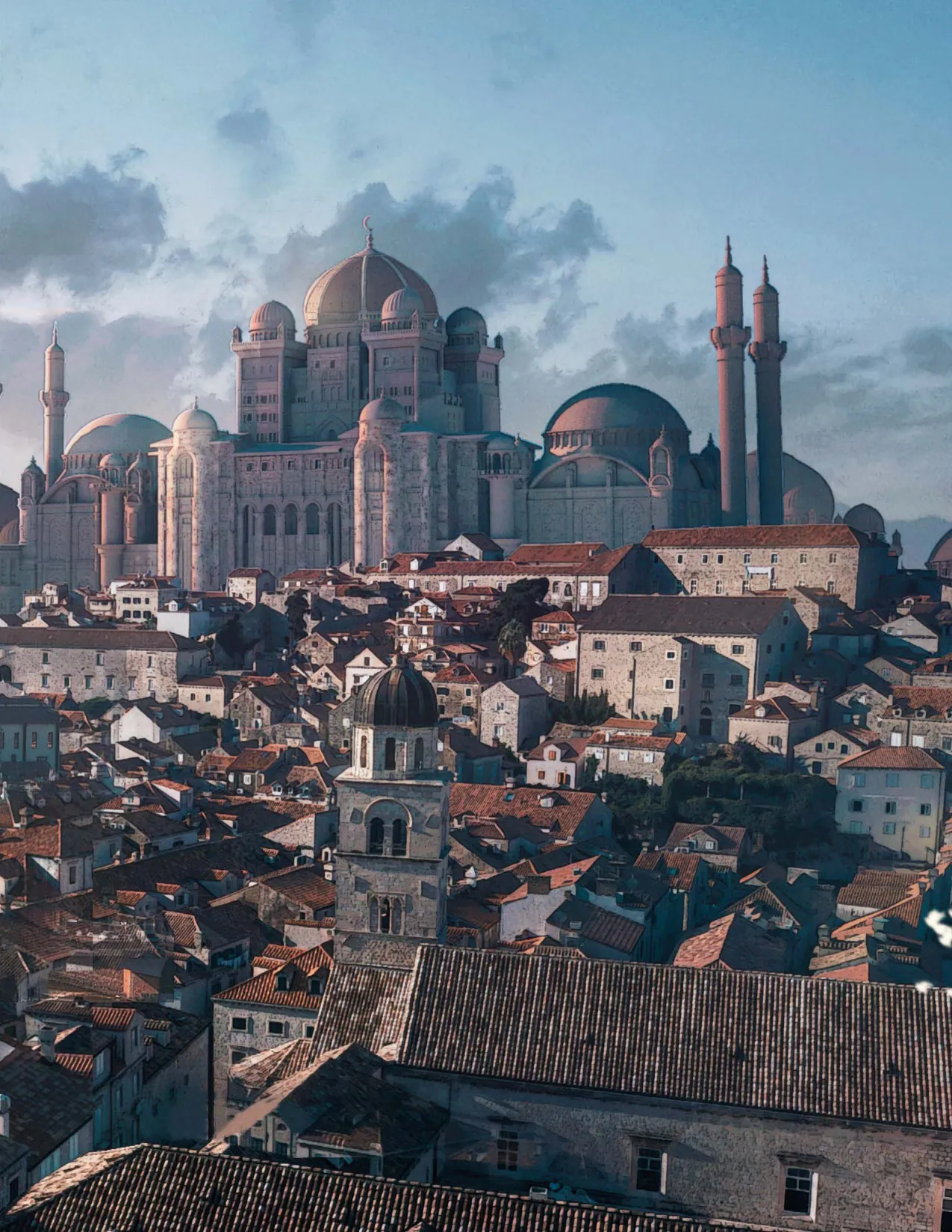
The skyline of Mytros is crowned by immense marble temples, their domes and spires gleaming in the sun. Two hills rise above the harbor. The first holds the city’s sacred and political heart: temples, courts, and the royal palace. The second is the bustling mercantile center, alive with markets and trade halls. Between them lies the Stygian Row, a dense sprawl of slums and forgotten alleys.
Behind the city looms Mount Volkan, an extinct volcano named for Mytros’s divine husband. From its heights, one can see the Mithral Mountains and the distant Oldwoods. With nearly 50,000 residents, Mytros is the most diverse city in Thylea, home to every known species. Its streets are swept clean each night, and public cleanliness is a matter of civic pride—to the point that riders are scorned if their mounts foul the roads.
By day, the sun casts a dazzling brilliance across the marble façades. The heat shimmers in the air, turning Mytros into a vision of gold and ivory, like a city glimpsed in a dream.
Factions in Mytros#
Mytros is not a united city. A number of factions compete for influence over the citizenry.
Queen Vallus#
Vallus has been the queen of Mytros for centuries, but she is far removed from her people. As the goddess of wisdom, she is viewed as the natural successor to Mytros, her mother, and her right to rule is affirmed by the Temple of the Five. However, as the Oath of Peace (appendix D) fails, faith in the Five Gods has waned, and people are growing restless with anxiety about the Titans.
King Acastus#
Acastus has been the king of Mytros ever since he persuaded Vallus to marry him, some twenty years ago. He is extremely popular in the city, especially since he obtained a huge silver dragon. The blood of Estor Arkelander flows in his veins, and many view him as the successor of the ancient Dragonlords. Most believe him to be a strong and wise ruler, or else why would Vallus have married him?
The Order of Sydon#
The Order of Sydon are devout worshipers of the Lord of Storms. Although the Titan sent hurricanes to punish the city for its faith in the Five Gods, a surprising number of people worship him and support the Order. Commander Gaius is often seen flying over the city on his silver dragon, and he’s a popular figure with young men and women who dream of joining the Order.
The Cult of the Snake#
The Cult of the Snake are known for their abiding loyalty to a mysterious figure called the Lady of Coins. Those who displease the Lady are often found turned to stone, with a green snake painted on a nearby wall. The Cult of the Snake is actually a thieves’ guild, and hence its influence is covert rather than open. Most of the thieves in the city are loyal to the Lady.
The Cult of Lutheria#
The Cult of Lutheria is the oldest cult in Mytros, filled with unabashed worshipers of the Lady of Dreams. Most people find their beliefs and rituals to be repugnant, but they are tolerated because they provide wine and entertainment for the popular wine festivals. In truth, they would have been ejected from the city a long time ago, except that they have “friends in high places”—devotees among the aristocracy.
Events in Mytros#
These are events that can occur in Mytros while the heroes are exploring the city.
Event: The Great Games#
The Great Games begin when the pyre is lit beneath the ruins of the Colossus of Mytros (area M15). Some people in the street notice the heroes looking at the torch bearer. They cheerfully explain that anyone, even great heroes, can enter the Games. If the heroes wish to enter, then refer to The Great Games section in this chapter.
Event: The Funeral Sacrifice#
This is a funeral procession for a dozen centurions killed fighting the centaur tribes on the borders of civilization. The women wail in an ostentatious display of grief for the dead while children look on dumbstruck and slightly scared by the caged beast.
The caged Minotaur Warrior (appendix B) is for a ritual battle before the funeral. Most citizens of Mytros consider minotaurs to be murderous brutes, fit only for use in games and rituals. They are sometimes captured by slavers and forced into Oaths of Servitude. Once they’ve been exhausted by years of forced labor, they are entered into gladiatorial games, where most of them are eventually slaughtered. Refer to the Slave Market (area M21) for details about this dark stain on the culture of the city.
The procession stops just outside of the Royal Gate (M6), where a group of pyres has been lit for the dead soldiers. Nearby, a walled pen has been constructed for the funerary games. A group of three Soldiers (appendix B), family members of the deceased, will be chosen to fight the minotaur. A Priest of Sydon announces that the sacrifice of the minotaur is a blessing for the dead.
Ritual Combat. The soldiers fight the unarmed minotaur to the death. As long as the heroes do not interfere, one of the soldiers will be badly injured but the minotaur will be defeated and killed. Intervening on the side of the minotaur will earn the heroes sour looks and suspicious gossip among the superstitious citizenry.
Optional Event: Bullbug. You can replace the minotaur with Bullbug (appendix A). Bullbug easily defeats the soldiers, but he refuses to kill them. Now freed, he calls out a friendly challenge to the heroes. If one of the heroes can beat Bullbug, he will offer to join their crew.
Event: Statues of Terror#
The gathered citizens will agree that the statue is remarkably lifelike, but none of them recall having seen it before. Centurions arrive within minutes and ask everyone to clear away. The centurions explain that this looks like the work of the Lady of Coins, as though the heroes should know exactly what that means.
If the heroes express interest, the centurions tell the heroes to speak with the powerful merchant, Lord Taran. He has called for the Lady of Coins to be brought to justice. The centurions are mildly surprised that he is still alive. Lord Taran can be found at his villa on the Neurdagon Estate (area M11).
Random Encounters#
These encounters are an easy way to add color to the city. Roll on the Random Encounters in Mytros table whenever you want something unusual to happen in the city.
Rumors in Mytros#
Mytros is the center of trade in Thylea, and so it is a place where stories from all corners of the land can be heard. These rumors might be overheard on the streets, in marketplaces, or in taverns:
Temple District Key Locations#
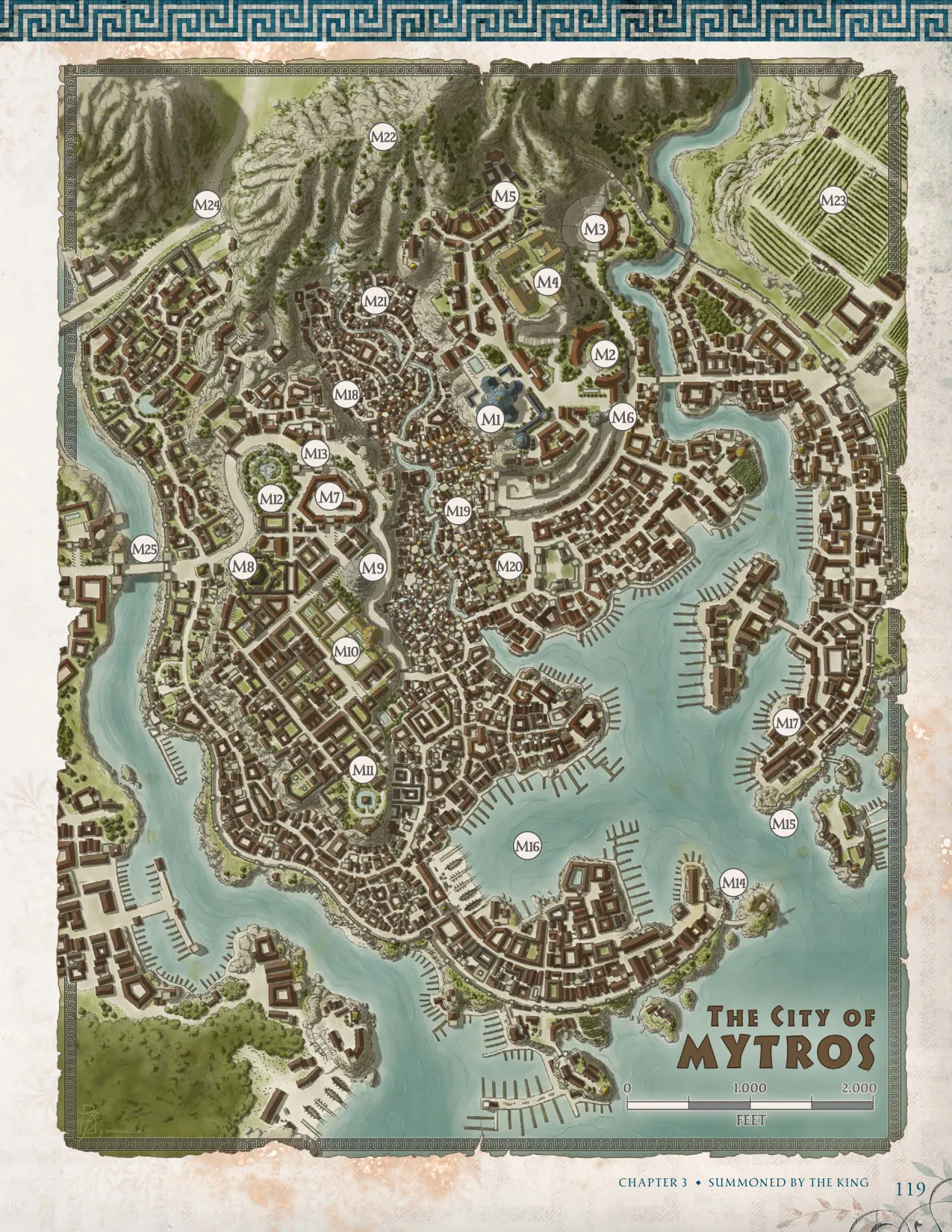
The Temple district is so named because it is home to both the ancient Temple of the Five and the newer Temple of Sydon. This is the center of religious and civic power in Mytros. It’s also where the Great Palace can be found. Everything in this part of the city is impressive: the Theater of the Gods can hold crowds of thousands, while the Academy is one of the greatest centers of learning anywhere in the world.
M1: Temple of Sydon#
This temple is the primary place of worship for Sydon in all of Thylea. The temple itself is a peripteros with 48 columns. It is built on a high podium that is accessed by an imposing set of steps shaped like ocean waves. A stair at the center of the temple leads to several underground chambers where the paladins of Sydon meet to discuss the Order’s many plans.
The Order of Sydon are headquartered here. They are a band of zealots who revere the ocean god Sydon above all others and seek to end all worship of the Five.
During the day, the temple is filled with citizens who come to hear the teachings of Sydon or receive blessings from the priests. During these busy periods, at least three
- Priests of Sydon with six Soldier Captains (appendix B) as protectors can be found within. At night, the temple proper is quiet, although the underground chambers are occupied by priests and soldiers. Gaius and His Dragon. The highest-ranking member
of the Order of Sydon is Commander Gaius (appendix A). During the day, he can often be found in the Great Palace (area M4), but at night he is usually here. Gaius is a true believer—a zealot who knows that the Five are false gods, thieves who stole the power of the true god, Sydon.
According to Gaius, the Five are useless pretenders: Pythor is a carousing drunkard; Kyrah composes terrible poetry; Vallus preens herself in an ivory tower; and Volkan is a crazy old dwarf who builds useless trinkets.
Once the heroes sail into the Cerulean Gulf on the Ultros, Gaius will move to the Island of Yonder, where the Order of Sydon have a base. He is able to move between Yonder and Mytros easily due to a gift given to him by Sydon: Argyn (LE Young Silver Dragon).
Argyn was bred by Sydon at his tower, Praxys. The dragon has been conditioned to believe that the Five are evil and that Sydon is the one and only force for good in the world. Argyn’s presence in the city is the subject of widespread gossip and admiration, but the dragon’s very existence infuriates Queen Vallus.
M2: Temple of the Five#
This temple is the oldest civic building in Mytros. Elected representatives from the city’s districts and the outlying villages meet in council here every new moon. However, the structure of civic life is increasingly dictated by the Order of Sydon, who believe that the Temple of the Five should be destroyed in order to appease the jealousy of the Lord of Storms.
Queen Vallus often visits here. During the day, she can be found at the palace, where she runs the city’s civic affairs. She comes here at night to pray to her mother, Mytros, the Goddess of Dawn. The temple is tended by five high priests (LG Priests) and each high priest is attended by five Priest Acolytes. The priests provide all common temple services at no charge, including the Lesser Restoration and Greater Restoration spells.
Test of Beauty and Wisdom. Outside of the temple during the day is a gang of young men who are admirers of Vallus. They are led by a vain young man named Sulla (LN Priest Acolyte), the youngest son of the powerful merchant Taran Neurdagon.
Sulla is enamored with Vallus and spends all of his time trying to gain an audience with the goddess or catch a glimpse of her as she leaves the temple. Vallus finds the young man obnoxious. She ignores him entirely, much to his chagrin. The last time he tried to gain her attention, Vallus told him that she would agree to have an audience with him if he brought her a single mortal of unsurpassed beauty and wisdom.
Sulla has heard of the heroes’ exploits. He will single out the hero with the highest Charisma score and another with the highest Wisdom score. He begs the two heroes to accompany him to see Vallus. If the party agrees, then Sulla will take them directly to the queen.
Vallus is amused by the fact that the heroes have been roped in by Sulla, and so she will humor them. Sulla presents the two heroes and extols their beauty and wisdom, hoping to impress her. Vallus remains unmoved, pointing out the heroes’ various flaws.
This forces Sulla into the realm of hyperbole—the heroes are the wisest, most beautiful creatures ever to grace
the city! Vallus reluctantly agrees until, finally, Sulla’s unrequited affections have been completely transferred from the queen to the heroes.
Sulla proposes marriage to each of the heroes, offering a gold ring inset with a diamond worth 1,000 GP. Whichever hero agrees to marry the young man gets the ring. The agreement is not binding, but this entire situation greatly amuses the queen.
M3: The Theater of the Gods#
The theater has a marble stage that extends in front of an orchestra pit and has a four-tiered seating area that ascends the slope of the hill. The building behind the stage has rooms for actors to prepare and storage for props and movable scenery.
The Wine Festival. The theater usually stands empty, but if the wine festival is happening in Mytros, then it will be busy for a full week. For details, refer to the wine festival event found in area E1 in the City of Estoria section of chapter 2.
M4: The Great Palace#
While not nearly as grand as the city’s temples, this palace is still an impressive building. The stairs lead to an expansive antechamber that connects to the throne room in the Royal Hall. This is where King Acastus can be found during the day.
The heroes are summoned here when they first arrive in the city. King Acastus is usually accompanied by his advisor, Chondrus (appendix A of Odyssey of the Dragonlords), his concubine Bella (CN Noble), and Gaius (appendix A), commander of the Order of Sydon. Acastus is always protected by five of his best centurions (LG Soldier Captains, appendix B).
M5: The Academy#
The Academy is spread throughout more than a dozen buildings. This is one of the greatest centers of learning not just in Mytros but in all of Thylea.
The Great Library. This building contains scrolls detailing knowledge on the flora and fauna of Thylea as well as information on topics such as metallurgy, alchemy, medicine, cartography, and almost any other imaginable subject.
The Hall of Heroes. This building is devoted to recording the heroic exploits of Thylea’s heroes throughout the ages. Marble statues and busts of all of Thylea’s heroes can be found here as well as scrolls of their histories and songs.
The Schools of the Arcane. The schools consist of eight buildings devoted to the study of the eight schools of magic, each headed by an arcane master (LN Mage).
The Great Orrery. This building contains a replica of the many planes of existence, represented as celestial spheres fashioned from bronze clockwork.
The Hall of Debate. The hall provides a forum where any philosophy can be discussed without repercussions, even if it veers into the theological. Some of the greatest minds in Thylea can be found debating philosophy here:
Machaon (CG half-orc Mage)
Chalcodon (LG elf Noble)
Kerodotos (NG gnome Priest)
Atreus (CN tiefling Soldier Captain)
The Academy is well protected and if anyone is foolish enough to make trouble here, they will be quickly subdued by the arcane masters.
Event: The Great Debates. The heroes are invited to participate in a series of philosophical debates at the Hall of Debate. Machaon, Chalcodon, Kerodotos, and Atreus all wish to test the intellectual mettle of the so-called “Saviors of Thylea.”
Each of the philosophers poses a paradoxical problem to the heroes and then awaits a response. There are no
right answers to these puzzles: the philosophers want to see how the heroes behave in the debate and will be impressed if the party takes the exercise seriously. They will be disappointed if the heroes are sarcastic or silly in their responses.
Machaon. The famed ship that brought the Dragonlord Adonis Neurdagon from the old lands to the lands of Thylea was the Valorous. The Valorous had sixty oars, a single mast, and a great prow. Over the centuries, it has decayed, and the Neurdagon family removed the old oars and planks, replacing it with newer and stronger timber. They replaced the mast when it was cracked in a storm, and they replaced the prow when the ship ran aground. After five centuries, every single piece of the Valorous has been replaced.
Is the Valorous now the same ship that once carried Adonis Neurdagon, or is she a different vessel?
Chalcodon. Pythor is in a footrace with a tortoise. Pythor allows the tortoise a head start of 300 feet. If we suppose that each racer starts running at some constant speed (one very fast and one very slow), then after some finite time, Pythor will have run 300 feet, bringing him to the tortoise’s starting point. During this time, the tortoise has run a much shorter distance of only 30 feet. It will then take Pythor some further time to catch up to those additional 30 feet, by which time the tortoise will have moved even farther ahead. It takes more time for Pythor to reach the third point, while the tortoise continues to maintain his lead …
Thus, whenever Pythor arrives somewhere the tortoise has been, he still has some distance to go before he can catch the tortoise, despite running much faster. Does this mean, then, that Pythor will never catch the tortoise?
Kerodotos. A sphinx captures the young crown prince of Mytros. His mother comes to the sphinx and pleads for the return of her son. The sphinx replies that he will only return the prince safely if the mother can guess correctly whether or not he will indeed return the boy.
What is the problem here? As it turns out, there is no problem if the mother guesses that the sphinx will return him: if she is right, the boy is returned; if she is wrong, the sphinx keeps him.
However, if she answers that the sphinx will not return him, we end up with a paradox: if she is right and the sphinx never intended to return her child, then the sphinx has to return him, but in doing so, he breaks his word and contradicts the mother’s answer. On the other hand, if she is wrong and the sphinx actually did intend to return the boy, then the sphinx must keep him, even though he did not intend to do so, thereby also breaking his word.
Atreus. What is the nature of good and evil? Are they metaphysical properties that can be measured or changed? For example, if a man commits murder, his neighbors may call him evil. We may rightly say that he has evil properties. Hoping to atone for his act, this man may offer to pay the victim’s family gold pieces to compensate for their loss. Now, let us say that the victim’s family is
satisfied by the payment, and they forgive him, saying that he is no longer evil. The man had evil properties before he made the payment, but now he does not.
If properties of objects cannot be created or destroyed but merely transferred, where did the evil properties go? Are the coins now evil? Is the family evil?
Reward. For participating in the debate, the four great philosophers award the heroes signed copies of their books: Machaon’s Paradoxia, Chalcodon’s Mathematika, Dialogues of Kerodotos, and Atreus’s Metaphysika. The books are worth 1 GP each, and each takes 1 day to read. Studying all four books grants proficiency in Arcana.
M6: The Royal Gate#
This gate is always guarded by two Soldier Captains and twenty Soldiers (appendix B). They are extremely disciplined and refuse to engage in conversation with passersby.
Noble District Key Locations#
The Noble District is loud, crowded, and colorful. Merchants from all across Thylea come here to ply their trades at the Great Agora (area M7) and to keep their wealth in the Royal Bank. Many of the wealthiest citizens of Mytros have real estate here.
M7: The Great Agora#
Huge marble roofed colonnades or stoa provide shelter from the sun and the weather here. Twelve-foot-tall statues of the Five watch from the edges of the Agora. A new statue of Sydon stands at its center, and it towers higher than any of the statues of the Five. Merchants from all over Thylea gather here during the day to trade and sell all manner of goods: from foodstuffs such as fish, meat, wine, cheese; to animals such as cows, goats, and sheep; to pottery, clothes, and bronze equipment.
M7A: Grimmik’s Armory#
This shop is run by Grimmik (NG Soldier Captain, appendix B), a retired centurion who sells adventuring gear and equipment. All non-magical weapons, armor, and tools from the Player’s Book can be purchased here. He also has a single mithral ingot for sale, for 1,000 GP.
Grimmik is proud to have served the city of Mytros as a soldier, and he shows off several scars he earned in battles against the centaur tribes. He purchases all of his equipment from “a small workshop” in Estoria (E9).
M7B: Zorin’s Concoctions#
This shop is run by Zorin (TN Mage), a disgruntled alchemist who washed out of the Academy (area M5). He sells potions and lesser magic items.
Zorin spent years perfecting his potions, but all his teachers cared about were oratory skills. Unfortunately for him, he has a habit of insulting his audience in any long conversation. He opened his shop when it became clear that he had no future as a famous philosopher.
M10: The Bathhouse of Vallus#
There are several bathhouses located in the city of Mytros, but all of them pale in significance when compared to this one. Queen Vallus had this bathhouse constructed two centuries ago to celebrate victory in one of the Aresian campaigns. It is a place for exercise, business agreements, courtships, gossip—and even the occasional bath. While visiting the bathhouse is ostensibly free, there are several
- Priest Acolytes collecting donations.
M11: The Neurdagon Estate#
This is one of the most expensive villas in Mytros. It is home to the powerful merchant lord Taran Neurdagon (LN Noble). He is descended from the ancient Dragonlord Adonis Neurdagon and has access to immense wealth, although most of it is bound up in his sizable real
M7C: The Great Menagerie#
A hooded man introduces himself to the heroes as the Collector (LE Mage). He travels throughout Thylea and collects exotic beasts and creatures. He offers to sell any of them to interested heroes.
Caged Animals. The cages hold a muzzled Lion, a muzzled cheetah, a hooded Cockatrice, a hooded Harpy, a muzzled Brown Bear, a trussed up Goatling (appendix B), and a trussed up young centaur (Centaur Trooper). The Collector offers to sell any of these creatures for a paltry sum of 100 GP, but he stresses that all sales are final. With the exception of the young centaur, none of the creatures are trained. If released from their bonds, they will attack everyone around them. The young centaur will seek sanctuary at the Temple of Sydon.
Treasure. There is a locked chest in the shop that contains 50 PP and the Collector’s spellbook. The book contains all of the spells from the Mage spell list. The chest can be opened with a successful DC 15 Dexterity (Sleight of Hand) check using Thieves’ Tools.
M8: The Vault of Thylea#
The bankers are elves who have devoted themselves to the Mother Goddess (TN Druids). For a monthly fee of 1 GP, anyone can entrust their money, jewelry, gems, or other treasures to the bankers, who will store them in the network of tunnels beneath the huge oak tree.
M9: The Courts of Mytros#
The court building is circular and its interior has ten rows of seats that circle the entire inside circumference. At the center is a raised platform where both the accused and the accuser stand. Court cases in Mytros are decided by jury, and the court can accommodate more than 300 jury members at once, if required.
estate holdings. Taran doesn’t allow uninvited guests, but he is willing to make an exception for heroes who are willing to perform a specific task for him: he wants someone to track down and destroy the so-called Lady of Coins.
Guardians. The entrance to the estate is guarded by two Warrior Veterans. These stalwarts will turn the heroes away unless they mention the Lady of Coins, at which point, they will invite the heroes into the main courtyard to await Taran. The estate is also patrolled by two Soldier Captains and twelve Soldiers (both from appendix A) from the Order of Sydon.
Treasure. Taran keeps 500 PP and 5,000 GP worth of gemstones, jewelry, and other trinkets in a locked chest in the study of his estate. In addition, there are two jars of Blessed Olive Oil (appendix C). The chest can be opened with a successful DC 20 Dexterity (Sleight of Hand) check using Thieves’ Tools. The chest also contains the deeds for over 6,000 acres of land in the regions surrounding Mytros.
Quest: The Lady of Coins. When Taran eventually appears, he explains his predicament to the heroes. The Lady of Coins is a self-styled folk hero who robs from the rich and gives to the poor of Stygian Row. She has an intense hatred for the minotaur slave trade and aggressively attacks those who try to make an honest profit. Taran admits that he makes a large portion of his wealth from the slave trade, so his business suffers more than most.
Taran explains that the Lady is cursed—she is a medusa who petrifies anyone who crosses her. Furthermore, he explains that barbarians are violent fools, but minotaurs especially are violent beasts with limited intelligence who revel in bloodshed, and the fact that the Lady of Coins
has an affinity for them speaks volumes about her character. Taran also suspects that she is behind the Cult of the Snake, a thieves’ guild deeply involved with smuggling and murder.
Reward. Taran offers the heroes 5,000 GP for the Lady’s head. However, a successful DC 15 Charisma (Persuasion) check can get him to go as high as 10,000 GP and offer a magical item, the Greatclub of the Cyclopes (appendix C). He advises the heroes to begin their search for the Lady in the Stygian Row.
M12: The Great Gardens#
The Great Gardens of Mytros are held to be the most beautiful in all of Thylea, boasting many paths, trees, flowers, ponds, and fountains to heal the restless spirit. The gardens are surrounded by perfectly-ordered oak trees, all of which are five centuries old. These oaks were planted when the city was founded.
Vitalis (LN halfling Commoner) resides here. This corpulent halfling is sometimes called “Vitalis the Fat” or “Vitalis the Fragrant” (although never to his face). Many believe him to be the wisest mortal in Mytros. Vitalis lives, sleeps, and eats in the gardens, and he is well-fed by his many admirers.
However, his personal habits don’t seem particularly wise, as he dresses in rags and never cleans himself. He also flatulates, belches, and harasses everyone who passes by. Some of his favorite insults include:
“It looks like your face caught fire … and someone
tried to put it out with a hammer!” “You’re so ugly that when your mother sent you out to
play, they fined her for littering!” “Mirrors reveal many things, but they cannot talk …
and lucky for you, they can’t laugh, either!” “You there! Turn around. Hmmm … I can tell that
you’re a centaur, but all I can see is the rear end!”
Seeking Advice. Despite his foul demeanor, Vitalis deserves his reputation. He gives out sound advice to anyone who pays him in fine food or wine. He devours the offerings and then answers questions in a drunken haze, one question per person who feeds him. Treat this as an equivalent of the Divination spell.
On subsequent or follow-up questions, he will shoo interrogators away, tell them that they must make their own mistakes if they are to learn anything, and probably pass wind from one end or the other.
M13: The Commerce Gate#
This is a sister to the Royal Gate. The road here is twice as wide as the way to the Royal Gate because it has to accommodate mercantile traffic coming and going to the Harbor. The gate is guarded by two Soldier Captains (appendix A) who keep an eye out for riff-raff from the Stygian Row.
Harbor Key Locations#
The harbor of Mytros is the largest in Thylea. Dozens of ships that ply the sea lanes of the Cerulean Gulf can be found anchored in the bay, while others are in dry dock, undergoing repairs.
M14: Colossus of Pythor#
This colossus is one of the wonders of Thylea. The twin colossi were constructed during the First War with the aid of Volkan, God of the Forge. In times of need, the statues could be activated to defend Mytros. Refer to the Colossus of Pythor section in this chapter for details.
M15: The Ruined Colossus#
This colossus was destroyed two centuries ago and the tale is still told with horror by the people of Mytros. The Kraken, a terrifying creature from the Forgotten Sea, attacked the city during a powerful storm. The twin colossi wrestled the creature back into the ocean, but the Colossus of Mytros was torn apart in the struggle. She returned to her guard post and collapsed into ruin.
M16: The Dockyard#
The dockyard is always bustling during the day. Although many merchants trade and bank in the Noble District, many come dockside to work and barter. There are bargains to be had with the many ships that arrive here from across Thylea. There are also more than a dozen dry-docks where ships are repaired.
M17: The Fish Market#
The fish market is especially crowded in the afternoon, when the fishing boats start returning from the Cerulean Gulf. Fish of every sort can be found on sale here, including unusual catches like sharks, eels, and octopuses. Quality fishing supplies can also be purchased here, including bait, tackle, and nets.
The Ancient Mariner. One of the merchants here is a dwarf who has sailed Thylea’s oceans for over 500 years. His name is Samuel (TN Warrior Veteran), and although he’s lost dozens of comrades to the treachery of the seas, he still makes sacrifices to the Lord of Storms. Samuel has lots of useful sailing advice to offer to heroes who are willing to listen to him. One of his favorite stories to tell is about a legendary city on the back of a dragon turtle that wanders the Forgotten Sea.
Stygian Row Key Locations#
The Stygian Row is a wretched hive of scoundrels and sell-swords. This is a den of iniquity where any vice may be freely indulged and Lutheria is openly revered. This part of the city never sleeps, as drunken revelers parade through the streets at all hours of the night, and merchants hawk their illicit goods in broad daylight.
Both half-orcs and tieflings are common in this district, though neither species is particularly villainous, especially when compared to the loathsome humans who manage the Slave Market (area M21).
Tiefling Enclave#
The district gets its name from the word that many Thyleans use for tieflings—“Stygians.” Five hundred years ago, this district was established as an enclave where tieflings could be corralled, because they were thought to be untrustworthy spies of Lutheria.
Half-Orc Enclave#
Half-orcs in Thylea are not mistrusted as they often are in other lands. When the original settlers learned that no orcs lived in Thylea, many of the half-orcs among them realized that they needed to live in close proximity to keep their bloodline alive. They decided to settle alongside the tieflings.
M18: The Siren’s Roost#
The woman is Ambrosia (NG siren Noble), the owner of this tavern. She genuinely seeks to entertain her guests with fine music, wine, and “interesting” company. Unlike similar establishments, she does not discriminate against satyrs, minotaurs, or centaurs, but she does prefer to entertain rich clients and famous heroes.
When engaged in longer conversations, Ambrosia makes it clear that she despises Julius, the owner of The Satyr’s Tail (area M19), who used to send thugs to collect “protection” money. Now, she employs Vorena (LN half-orc Soldier Captain, appendix B), a taciturn former centurion, to protect her establishment. Vorena does her job well. Each of Ambrosia’s escorts claims to trace their lineage to a god or a nymph, so clients can pick their preferred flavor of “immortality.”
Son of Pythor. One of the escorts is Kalistor (CG Spy), who is actually a child of Pythor. He has met his father only once, and they didn’t get along. He is quick to fall in love with any hero who has 18+ Strength.
Quest: Kidnapped Children. Kalistor spends his time in Mytros trying to undermine the Temple of Lutheria (area M20). He believes that Trellus and Septia are keeping children locked in their wine cellar for use in human sacrifices. He has no rewards to offer, but he emphasizes that, if the rumors are true, then rescuing the children would be the right thing to do.
M19: The Satyr’s Tail#
The sailors who come to this tavern drink to forget what they’ve seen on the waters of the Cerulean Gulf. The wine here may be over-sweet and watered-down, but it’s also cheap and plentiful.
The taproom is filled with smoke and smells of fish and unwashed bodies. The tavern is run by Julius (CE
Warrior Veteran), a nasty old man and former slave trader. He had his own galley before he ran afoul of Cerulean pirates and lost everything, including his left arm. He doesn’t like seeing his patrons bothered. If the heroes disturb his regulars, he’ll send three of his bouncers (CE
Toughs) to remove them from the premises. Fryxon, a Satyr, befriended Julius a few years back. He
provides music for the tavern. If a fight breaks out or the bouncers need help in removing someone, Fryxon will use his Fey Lullaby to help put aggressors to sleep.
The Cult of the Snake. This is one of the only places to find information about the Cult of the Snake. Fryxon loves to cause mischief, and if asked about the thieves’ guild or their Lady, he will loudly introduce the questioners to Grecos and Nero (see below).
Tavern Patrons. The tavern is crowded day and night by sailors, bandits, thieves, mercenaries, and other miscreants.
Varkon’s Crew. One of the captains is Varkon (CN Bandit Captain), a half-orc who is accompanied by a half-dozen of his sailors (CN Bandits). They are a rowdy bunch, boasting about their adventures in the Cerulean Gulf. Varkon often works for the Lady of Coins, and he isn’t afraid to drop her name as a threat. He knows the route that leads to the Island of the Dragon, so the Lady of Coins uses him to deliver petrified musicians and performers to Hexia. Varkon also knows where to find the Cult of the Snake’s secret entrance into the Colossus of Pythor.
Grecos and Nero. Another table is occupied by two thieves who are members of the Cult of the Snake. They always visit The Satyr’s Tail after successful robberies in order to celebrate by spending their ill-gotten gains. Grecos and Nero (CE Spies) are brothers who love to insult the other patrons with sarcastic remarks. They are also fiercely loyal to the Lady of Coins and, if they notice the heroes investigating the Lady, they will split up. Grecos will let the Lady of Coins know that the heroes are interested, while Nero will try to follow the heroes.
Wine Merchants. Trellus and Septia (apparently NE Commoners when they appear in public) from the Temple of Lutheria (area M20) sometimes drop by to deliver new wine to Julius. They are looking for mercenaries to help them track down some missing wine caravans.
M20: Temple of Lutheria#
The temple is maintained by a family of wine merchants keen to promote the worship of Lutheria so as to serve their business interests in the city. The high priest is Trellus (LE Cult Fanatic) who is served by six Cultists in black robes. His sister and lover, Septia (CE Mage), secretly plots to become queen of the city. The siblings officiate in ritual kidnappings and human sacrifices performed every full moon, although they are careful not to kill anyone who might be missed.
Admirers of the Horn. If the two discover that the heroes have the Horn of Balmytria (appendix C), they will offer to buy it for 5,000 GP. If the heroes refuse, then they will secretly plot to kill the party and take it.
Quest: The Missing Casks. Recently, several wine caravans that should have reached the temple have gone missing. The siblings believe that bandits are hiding out in the woods near the Vineyards of Mytros (area M23). They offer 2,000 GP if the bandits can be delivered to them alive (for use in ritual sacrifices) or 1,000 GP for the bandits’ heads.
Wine Cellar of Missing Children. The wine cellar of the Temple of Lutheria is a place of horrors. Trellus and Septia currently have thirteen children (NG Commoners) locked away inside, which Septia keeps warded with the Silence spell.
The children’s parents were sacrificed to Lutheria and their bones remain scattered throughout the cellar. The siblings intend to induct the children into their cult—and sacrifice those who resist. If the children are freed, they can be sent to Queen Vallus for protection.
M21: Slave Market#
Minotaurs are the most conspicuous prisoners. They are physically fit but filthy, their size and horns marking them as prized stock for the funeral sacrifices and the Great Games. Their presence reinforces Mytrosian prejudices that conflate bestial appearance with brute labor and slaughter.
City Border Key Locations#
M22: Mount Volkan#
The Great Games are held at the peak of Mount Volkan. The proving grounds for the Games are inside the basinlike crater of the extinct volcano. The Great Games are held outside of the city walls because they are considered a sacred event open to all. Every king of Thylea sends their best to compete in the Games.
M23: The Vineyards of Mytros#
These vineyards are owned by a dozen mercantile families that live within the city. For centuries, these vineyards have been cared for by a tribe of Satyrs.
Slaves in this market can be purchased for 100–250 GP, depending on strength, skill, and perceived usefulness. A dozen or more captives are usually on display, all recently acquired through raids or political reprisals.
There are three slave houses near the market, each owned by a wealthy merchant. These houses specialize in different “wares”: Aresian prisoners sold as laborers or servants, Indigo barbarians sold as gladiators, and minotaurs sold as beasts of burden or sacrifice. The captives are kept in conditions no better than cattle pens.
Encounter: Bullbug the Minotaur. One of the minotaurs for sale is Bullbug (appendix A), a large fellow even by minotaur standards. Bullbug calls out to the heroes, asserting that he would make an excellent addition to their party. Despite the conditions in the market, he is confident and friendly.
Maximus the Merciless. Maximus (LE Gladiator) is the slave master who runs the Slave Market. He keeps order in the market with the aid of twelve Toughs, and he heaps abuse upon the minotaurs. If any of the heroes are minotaurs and they pass through the market, he mistakes them for escaped slaves. In this case, he approaches the hero and attempts to shackle them, berating them for getting loose.
Treasure. Maximus carries 750 GP in his coin purse. He also carries a permit issued by Commander Gaius of the Order of Sydon. The document authorizes the “transfer of Oaths of Service,” establishing the system as slavery in all but name.
Encounter: The Fey Glade. If the heroes explore the vineyards, read the following:
This is where the caravans meant for the Temple of Lutheria (area M20) have gone. Satyrs have been waylaying the caravans and stockpiling wine casks in the glade. Boreas (NE Satyr Minstrel, appendix B) is here, playing a gentle tune upon his enchanted harp. He is accompanied by his brothers, three Satyrs who are drinking wine and entertaining a Dryad. Boreas has permanently charmed a water elemental that tends to the vineyards for him.
Keepers of the Vineyards. Boreas claims that the wine merchants struck a bargain with him years ago, for which he and his brothers were to be compensated in wine. The terms of payment were vague, but the satyrs interpreted it as one cask per month, as long as the vineyards of Mytros remain fruitful. They claim that they were the ones who enchanted the vineyards centuries ago, ensuring that the vines would flourish.
Trellus and Septia. The merchants, Trellus and Septia, are only humans with short memories, and they’ve broken the oath made by their ancestors. Boreas mocks the siblings, claiming that Lutheria will swallow their souls as punishment. He offers the heroes his Boreal Harp (appendix C) if they will bring him the heads of the treacherous merchants. If the heroes comply, he will smash the harp before handing it over, leaving behind a set of nymph-hair strings.
M24: The Soldier’s Gate#
This gate is always guarded by two Soldier Captains and twelve Soldiers (both in appendix B). They are replaced each hour by an identical squad from one of the towers along the road.
M25: The Harp Bridge#
This bridge is the gathering point for a flock of sirens. There are over twenty sirens in the flock, and they live in the estates to the west of the bridge. They gather here throughout the day to sing together, and their collective mood fluctuates from one day to the next.
There is a 50% chance that they will be joyful and a 50% chance that they will be mournful. On days when they are joyful, commerce in the city flourishes. On days when they are mournful, the city is more superstitious.
The Colossus of Pythor#
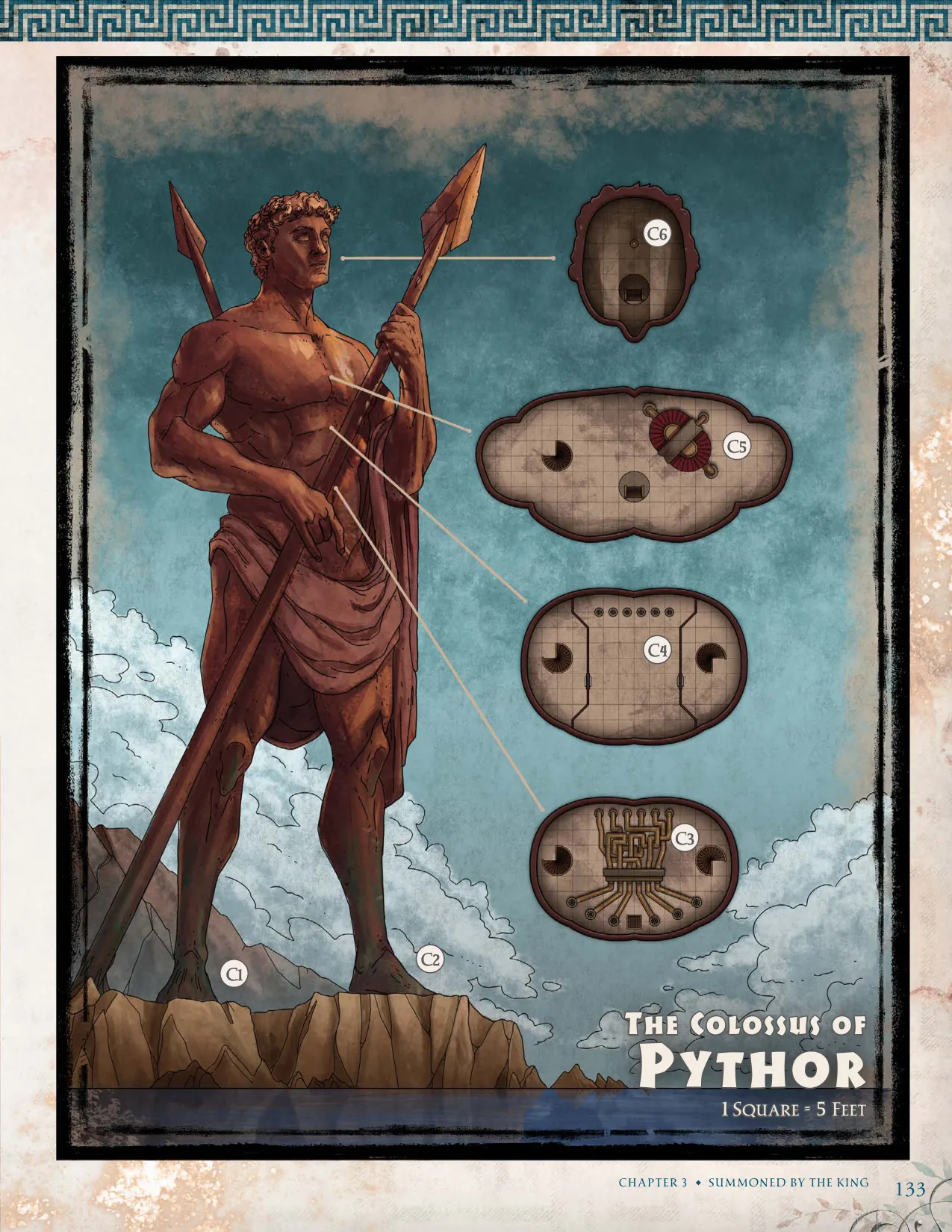
The Colossus of Pythor (area M14) is a hollow structure, but it is sealed and guarded. In theory, only King Acastus has the password and key to enter the Colossus but, unbeknownst to him, the Lady of Coins has tunneled up from the sewers. Her servants have built a secret entrance into the interior of the great bronze statue, allowing her to use it as a base of operations.
Cult of the Snake#
The Cult is a thieves’ guild that operates in the city’s shadows. They have a headquarters deep within the aqueducts. The cultists have recently been breaking into the homes of wealthy citizens, stealing everything of value, and leaving entire families literally petrified.
The leader of the cult is a medusa who calls herself “the Lady of Coins.” She is the sister of Thesilea, the queen of the Amazons, but she fled the Island of Themis after a failed attempt to depose her sister. Refer to the Island of Themis in the Cerulean Gulf section of chapter 2 of Odyssey of the Dragonlords for details.
Servants of Hexia. Moxena and her minions serve Hexia, the green dragon, and ferry spoils to her by ship once per year. In return, the wyrm shares ancient valuables from her hoard, feeding the medusa’s ambition. Hexia has peculiar tastes anyway: the spoils she wants are actually musical instruments and the musicians to play them. They are transported to her in petrified form and she releases them for entertainment at her leisure. Refer to the Island of the Dragon in the Forgotten Sea section of chapter 3 of Odyssey of the Dragonlords for details.
C1: Main Entrance (Right Leg)#
The locked and guarded main entrance is in the heel of the right foot of the colossus. Two Marble Golems (appendix B), each resembling Pythor, flank the door on the outside. If someone tries to open the door without first speaking the password, one golem’s head will turn to look at the intruder menacingly. If the intruder continues, the marble golems will attack.
The door is locked with Arcane Lock. If the Arcane Lock is suppressed by the Knock spell or otherwise dispelled, then the box can be opened with a DC 15 Dexterity (Sleight of Hand) check using Thieves’ Tools. The spell can be temporarily negated by speaking the password, “Adonis.” This password can be obtained from Vallus.
Inside the leg, a spiral staircase ascends to the room in the belly of the colossus (C3).
C2: Secret Entrance (Left Leg)#
This entrance has been bored from the sewer system and the room was created with the Disintegrate spell. The hole is only two feet wide, and a makeshift rope ladder hangs down from the room in the belly of the colossus (C3). A Tough guards the entrance. If he sees intruders, he rings a bell that hangs beside him before taking any other actions, warning his comrades that there are trespassers in the colossus.
C3: The Statue’s Belly#
The belly of the colossus is filled with large tubes that resemble intestines. These tubes do serve an important function for the colossus, supplying the chemical biles and humors that power the automaton. The pipes transport the biles to all of its extremities.
The Bile Traps. There are four different biles: red, green, black, and yellow. Some of these are poisonous to humanoids. The four valves in the chamber give access to the different types of bile. When any bile comes into contact with air, it turns into a gas and retains its coloration. Opening a valve takes an action, and the room fills with gas at the start of the next round:
Valve 1 (Red Bile). This odorless gas will cause fits of hilarity. Anyone who breathes it in must succeed on a DC 10 Constitution saving throw or have the Poisoned condition. Affected creatures have the Incapacitated condition as they go through a fit of laughter for 1 minute. The creature repeats the save at the end of each of its turns, ending the effect on itself on a success.
Valve 2 (Green Bile). This has a pleasant smell, but also a slow, progressive poisoning effect. Anyone who breathes in green bile vapor must succeed on a DC 10 Constitution saving throw or have the Poisoned condition. One round after being Poisoned, the victim will cough up mucus and take 10 (3d6) Necrotic damage. On the next round, the victim will cough up blood and take 21 (6d6) Necrotic damage. On the third round, the victim will go into a spasm, taking 10 (3d6) Necrotic damage, and has the Paralyzed condition. Each round while Poisoned, a victim can take an action to reroll the save, ending the effect on itself on a success.
Valve 3 (Black Bile). This vapor causes extreme sadness. Anyone who breathes it must succeed on a DC 10 Constitution saving throw or have the Poisoned condition for one minute. While Poisoned, they become utterly despondent, they have Disadvantage on saving throws, and their Speed is halved.
Valve 4 (Yellow Bile). This valve releases a harmless yellow gas that smells like rotten eggs. The foul smell lingers on clothing for one day, causing Disadvantage on all Charisma checks.
There are three Minotaurs of Baphomet in here, along with the female Bandit Captain. They are all resistant to the bile vapors, granting them Advantage on saving throws against the poisons. The captain tries to open the valves one at a time while the minotaurs engage intruders. The heroes can shut off one of the valves by using an action.
C4: The Statue’s Torso#
The torso chamber is a large cavity that resembles a stomach. The doors at either end are airtight, with small glass portholes built into them, and they are sealed shut when the heroes arrive. Pipes enter the room from both the ceiling and the floor.
The Acid Trap. This chamber is where the gasses that power the colossus are made. When the colossus is active, a powerful acidic liquid is pumped into the chamber and then heated to become a gas. This process can be activated by using an emergency lever on the outside of each of the exits to the chamber. If either lever is pulled, the doors seal and acidic liquid will pour into the chamber.
It takes two rounds for the chamber to fill. Anyone inside the chamber during this time takes 21 (6d6) Acid damage per round. On the third round, the walls of the room heat up to turn the liquid into gas, causing each creature touching the walls to take 21 (6d6) Fire damage in addition to the 21 (6d6) Acid damage. On the fourth round, the acid becomes gas and is then pumped out of the room. At this point, the doors open.
The process can be ended at any time by pulling either lever to the off position, which immediately drains the chamber and opens the doors. When the liquid is being heated, the only other way to open the doors is to cast a Knock spell or to succeed at a DC 30 Strength check to force them. If the doors are opened in any way, the process ends and the room immediately drains.
Two Minotaurs of Baphomet wait on the east side of the chamber, watching for intruders. They wait until at least two visible intruders are inside the acid chamber. Then, they move outside to pull the emergency lever. Anyone outside of the chamber at the west end will see the emergency lever move into the “ON” position, the doors will seal, and they can clearly see what is happening to their companions through the porthole.
Heroes outside the chamber can try to pull the lever to the “OFF” position by testing their strength against the minotaurs. The minotaurs have Advantage as they are using the Help action on each other, but the heroes can do the same. Once the chamber has been re-opened the minotaurs will rush forward to attack.
C5: The Statue’s Chest#
These are four cronies of the Lady of Coins (CE Toughs).
Heart of the Colossus. The furnace here looks like a heart, and it helps to power the colossus. It is usually dark and cold unless the colossus is active. However, if the
toughs hear any intruders below, they will power it up using a lever on the east side of the chamber.
The Fire Trap. Once active, the furnace begins to rumble rhythmically, once at the end of each round. The thugs will leave the furnace door open so that every time it “beats,” a jet of fire explodes into the room. The blast of fire extends from the opening in a 5 ft. wide stream to hit the back wall. The flames do 10 (3d6) Fire damage. Anything within 5 ft. of the back wall is engulfed in flames. The toughs know where the flames go, so they easily avoid the blast.
C6: The Statue’s Head#
The eyes of the colossus are windows that allow light into this chamber. Behind the curtains, the walls of the room are full length bronze mirrors, a dozen in all. A single cord can be pulled to drop all of the silk curtains and reveal the mirrors. Finding the cord requires a successful DC 15 Intelligence (Investigation) check.
The milky white orb that hangs from a bronze chain is the control mechanism for the colossus. Only someone in possession of King Acastus’s Rod of Rulership can activate the orb and take control. To do this, one must touch the rod to the orb.
The woman on the hammock is Moxena (appendix A), the Lady of Coins—and the leader of the Cult of the Snake.
The Lady of Coins#
The Lady of Coins (TN Medusa) keeps her lair in the head of the Colossus of Pythor. Although few in the city know it, her true name is Moxena. She commands her forces from here, using the chamber as her personal quarters. She wears a Ring of Warmth, which she expects her followers to kiss.
Statues for Hexia. There are three statues set up around the room—victims of petrification. They include a bard (Xollos, an absent-minded CN dwarf Bard), a poet (Sylla, a shy CG elf Noble), and a musician (Gondros, LN gnomish Commoner who believes he is the greatest composer of this time, and probably ever).
Moxena intends to ship these entertainers to her mistress, Hexia, on the Island of the Dragon in the Forgotten Sea. If the heroes are able to free the victims from petrification, they are immensely grateful and swear Oaths of Service.

Battling the Lady of Coins. In combat, Moxena will pull the cord that drops the curtains, revealing the circle of mirrors. She has trained herself to remain focused on one target, so that she doesn’t see her own reflection. This means that, with the mirrors revealed, Moxena’s Petrifying Gaze affects everyone in the room except for herself and targets who have the Blinded condition.
An Unlikely Ally. If Moxena senses that she has no chance of victory, then she will surrender to the heroes and propose a deal: she will join them on their quest. She has been using her thieves’ guild as a means to gather resources so that she can make war on her sister Thesilea, the Queen of the Amazons. She offers to show the heroes the way to Themis. There they may plunder the island for its many treasures, including the legendary sword Titansbane (appendix C of Odyssey of the Dragonlords), a powerful weapon that can be used against the Titans.
Moxena’s Treasure. There are two chests in the room. One chest contains Moxena’s personal effects, which include three jars of Blessed Olive Oil and a Game of Twenty Squares (appendix C). The other chest contains the money reserves collected by the thieves’ guild, which includes 55 PP, 450 GP, and 3,400 SP.