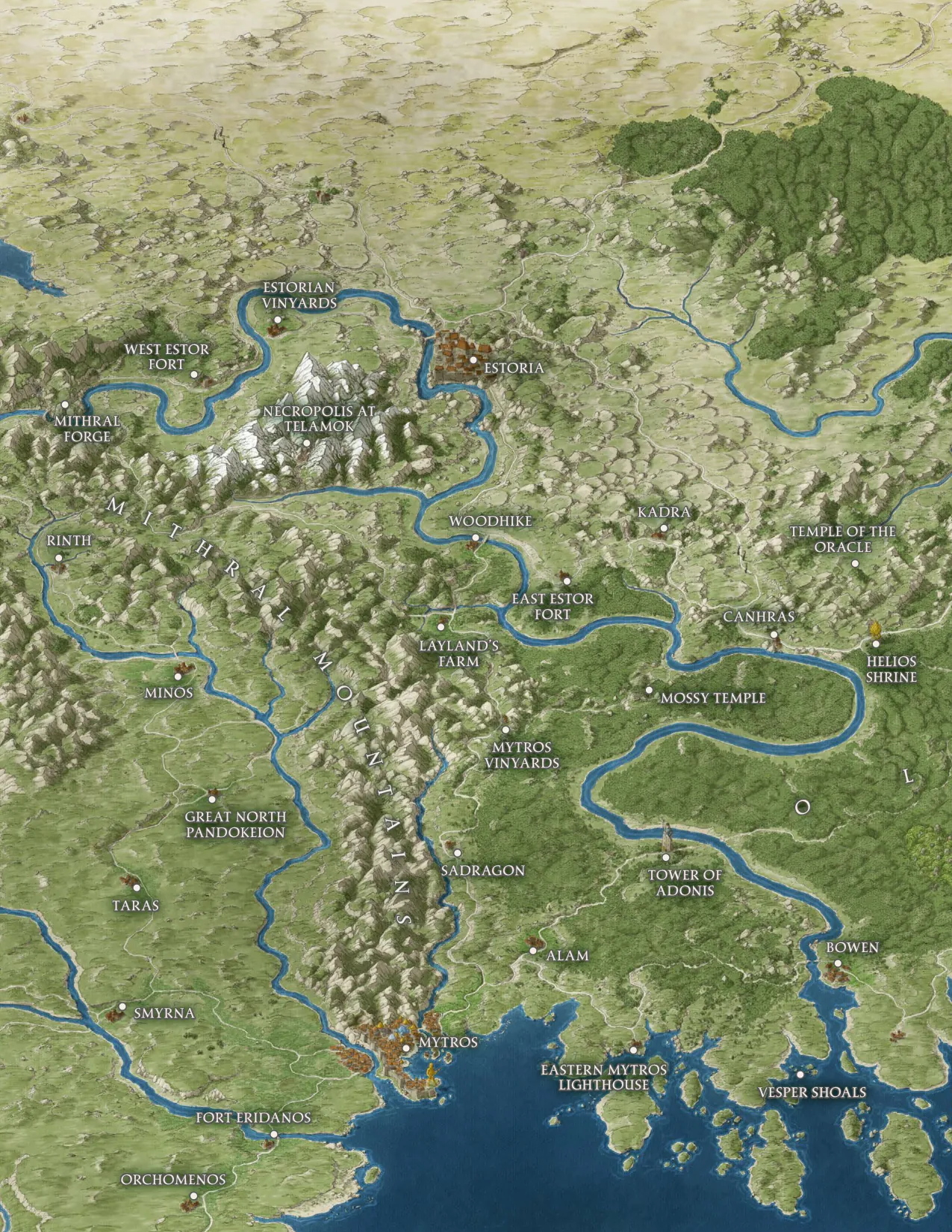
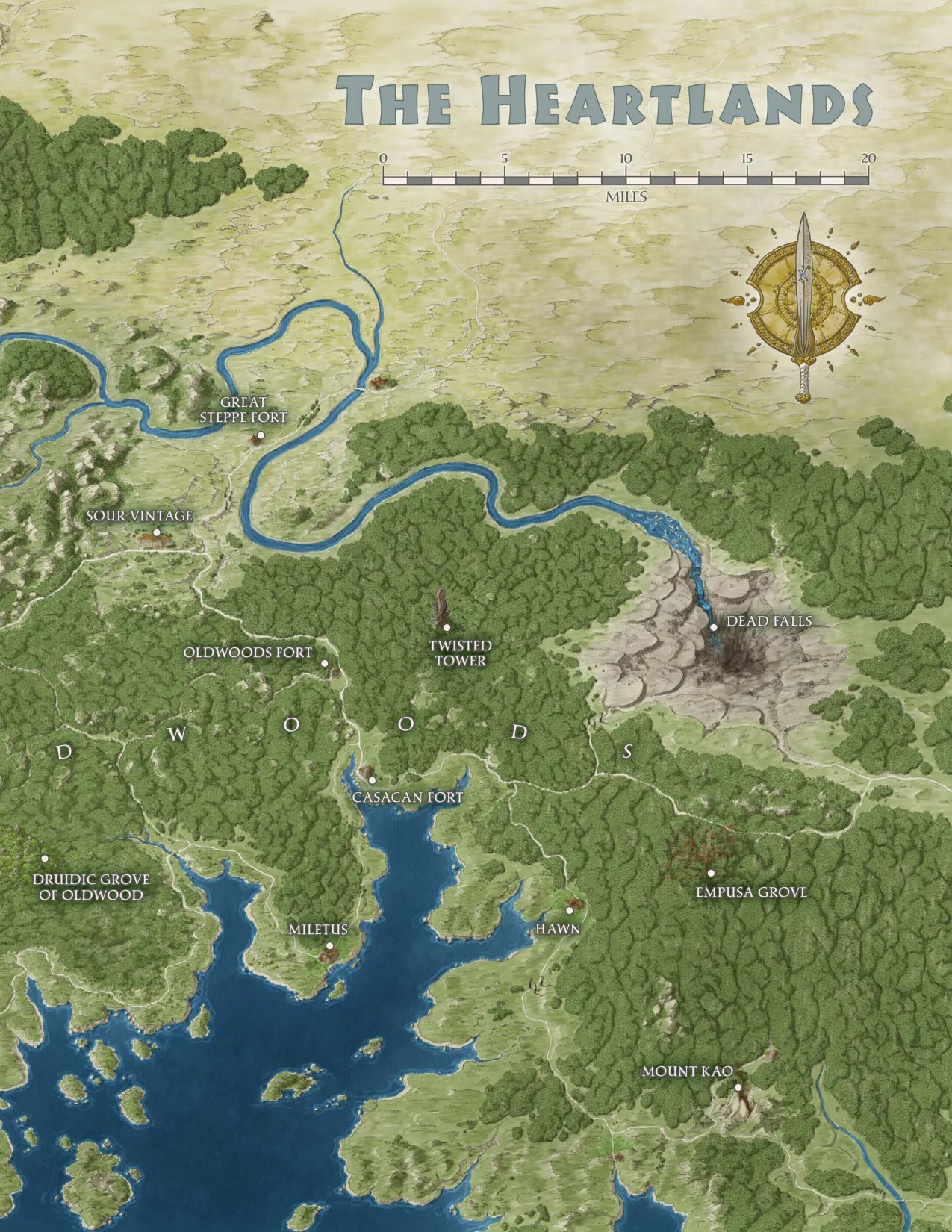
Known as the Heartlands for their reputation as the cradle of civilization in Thylea, this region stretches between the great city of Estoria to the north and the gleaming capital of Mytros to the south. Yet civilization here is not absolute. To the east, the ancient and untamed Oldwoods harbor secrets older than the cities themselves, while the towering Mithral Mountains rise to the west, their peaks sheltering forgotten strongholds and perilous passes.
Throughout the adventure, the heroes will be traveling across the Heartlands. Their first destination is the Temple of the Oracle.
Heartlands Key Locations#
The following locations are keyed to the map of the Heartlands.
Alam#
Population: 1,500 (90% human, 4% elf, 4% gnome, 2% halfling)
Ruler: Hector Adonis
Defense: 200 citizen soldiers (Soldiers, appendix B)
Products: Bronze, copper, gold work, horses, timber
Alam is a wealthy town thriving under the protectorate of Mytros. Enriched by the trade flowing into the great city, Alam has become a byword for prosperity throughout Thylea. Its citizens are famed for indulgence, with lavish feasts, rare delicacies, and extravagant entertainments. To outsiders, Alam’s opulence is a source of envy and disdain. None scorn it more than the Aresians, who condemn the town as a cautionary tale of decadence born from unchecked wealth. Indeed, they often speak of Alam and Mytros in the same breath, branding both as corrupt and indulgent.
For centuries, Alam has been ruled by the Adonis family. The current lord, Hector Adonis, bows in name to King Acastus and Queen Vallus, but relations are strained—and both monarchs regard him with thinly veiled contempt.
Bowen#
Population: 4,500 (94% human, 4% elf, 2% other)
Ruler: King Gregor Nikandros
Defense: 200 warriors of the Cerulean Brotherhood (Veterans)
Products: Fine ceramics, shipbuilding and timber
After Mytros and Estoria, Bowen is the largest settlement in the Heartlands, and its reputation extends far across the Cerulean Gulf. The city thrives as a naval power, its harbors filled with swift galleys and stout merchant ships that carry wine, olive oil, timber, and fine crafts to distant colonies along the coast. Shipwrights here are famed for their skill, blending artistry and engineering to produce vessels prized throughout Thylea.
Bowen is also home to the Cerulean Brotherhood, an elite company of paired warriors who swear oaths of loyalty and love to one another, fighting as unbreakable units on both land and sea.
The city’s influence stretches beyond its walls, maintained through far-flung colonies. Though smaller than Mytros or Estoria, Bowen wields outsized power through its fleet and its warriors.
Canhras#
Population: 150 (50% human, 50% dwarf)
Ruler: King Pythor
Defense: 20 citizen soldiers (Warrior Veterans)
Products: Statues, honey, medicinal herbs
A village with a large diaspora of dwarves from the Mithral Mines. The village owes allegiance to King Pythor.
Casacan Fort#
A coastal fort with a well-defended harbor, its massive walls are said to have been built by cyclopes more than a millennium ago. Conquered by the Dragonlords during the First War, it now serves as a bulwark against piracy in the Cerulean Gulf, sending ships to fight pirates in the region. There are a half-dozen triremes in port at any given time.
Dead Falls#
The Dead Falls mark a cursed point where the River Lethe vanishes into a mile-deep chasm—a silent, unsettling gateway to the Underworld. Travelers speak of haunted cliffs, screaming winds, and living rock that crushes intruders. Locals fear the place, calling it a path to Lutheria’s realm, where none return. Right before the falls there is a natural harbor where the ghost ship known as the Ultros can often be found. Refer to The Ghost Ship Ultros section in chapter 3.
Druidic Grove of the Oldwoods#
Deep within the Oldwoods is a druid grove ringed by monolithic stones. These druids are white-clad men and women who wear laurels and wield oaken staves. They worship the mother goddess Thylea, and believe that the people of Mytros should never have settled in her Heartlands. They perform a daily ritual sacrifice to Thylea, hoping to atone for the sins of the mortal species.
East Estor Fort#
The East Estor Fort stands on a rocky ridge overlooking the road between the Sour Vintage and Estoria. Within the walls lie a simple barracks, a storehouse for grain and oil, and a deep cistern that ensures water during siege or drought. From its heights, smoke signals can be sent to neighboring outposts. It has a garrison of 40 Soldiers (appendix B).
Eastern Mytros Lighthouse#
This beautiful lighthouse tower is manned by a dozen
- Soldiers (appendix B).
Empusa Grove#
Then she turns and runs into the woods.
The Lure**.** The girl is an illusion woven by the Empusa, Xanthe (appendix B). A character who succeeds on a DC 15 Wisdom (Insight) check realizes something about the girl is off: her voice doesn’t echo and her feet leave no prints. If the party follows, they are led to a clearing where a vast, blackened tree dominates the glade. Its bark is studded with glossy black eyes. Read the following:
Xanthe’s Plea**.** Xanthe is fully aware of what she’s become. Her victims whisper to her from within the tree, recounting her crimes in unending chorus. She does not pursue intruders, but if the heroes remain, she asks them to share a story—anything to quiet the voices.
A successful DC 15 Charisma (Performance) check moves her. She falls silent, then softly says:
Battle and Redemption**.** If the party agrees, fire is the surest way to destroy her, though it is dangerous. Xanthe does not resist until she is Bloodied, at which point the pain overwhelms her and she lashes out on her next turn.
If the heroes defeat her, read the following:
Each hero gains a Charm of the Empusa.
Estoria#
Population: 8,000 (84% human, 6% dwarf, 5% elf, 5% other)
Ruler: King Pythor
Defense: 200 citizen soldiers (Soldiers, appendix B)
Products: Fine ceramics, bronze armor, perfume oil, purple dye, and wine
Organizations: Order of Sydon
An ancient bastion on the frontier, Estoria has withstood generations of assaults from the wilds—centaurs, cyclopes, manticores, and other beasts that roam the windswept steppes. It stands as a symbol of resilience and martial strength, ruled by King Pythor, the God of Battle himself. Refer to The City of Estoria section of this chapter and appendix A.
Estorian Vineyards#
A vineyard run by a man named Thericles, a former servant of King Pythor. Refer to area E12 in The City of Estoria section of this chapter.
Fort Eridanos#
This stone fort guards the southern crossing of the River Eridanos, a vital route for merchants and travelers alike. Its walls rise above the riverbank, with watchtowers overlooking both the ford and the surrounding plains. A garrison of sixty Soldiers (appendix B) is stationed here.
Great North Pandokeion#
A central stopping point used by caravans for resupply.
Great Steppe Fort#
This is a large stone fortress that stands on a lone hill overlooking the Great Steppe. It owes allegiance to King Pythor, who sends soldiers and supplies to ensure it is always properly maintained. Its main entrance is a massive gate flanked by two carvings, one of a centaur kneeling, the other of a bronze dragon rearing up. It symbolizes the surrender of the centaur tribes to the Dragonlords during the First War.
The fortress houses 200 Soldiers (appendix B) to deal with incursions from centaur tribes and other dangers from the steppe. It has had to defend against many sieges, while its garrison has often had to sally forth to stop centaur raiders from terrorizing the Heartlands.
Nearby is the town of Veracan, which lies partially in ruins, for it has been the target of many centaur raids over the years. The farmers of the town provide the Great Steppe Fort with grain and wine.
Hawn#
Population: 250 (95% human, 5% other)
Ruler: Order of Sydon
Defense: 50 citizen soldiers (Soldiers, appendix B)
Products: Fish, lumber, oil
The village of Hawn is known for its devotion to Sydon, having turned its back on the Five. Life here is shaped by the Order of Sydon, whose enforcers rule with absolute authority. From Hawn’s docks, their ships sail regularly to the Island of Yonder, carrying supplies and recruits to sustain the Order’s stronghold there.
For the villagers, service to Sydon is both duty and aspiration. From childhood they are taught to fear and revere the Lord of Storms, and many dream of being chosen to join his Order. Yet only the strongest, cleverest, or most ruthless are granted the honor.
Helios Shrine#
Zephyrus (CN Satyr Minstrel, appendix B) is playing a Zephyr Lute (appendix C) and has permanently charmed the Shambling Mound that is dancing to his music. Neither he nor the shambling mound attack unless they are provoked, but they do not permit the heroes to explore the ruins. The satyr has a wicked sense of humor, and is not above passing comment on the heroes, their apparent prowess (in all fields of endeavor), their clothes, their equipment, their haircuts, their weaponry (“That’s a very tiny sword …”) and anything else he finds funny.
The Shrine Guardian. Zephyrus claims to be the guardian of the ruin, which was once a shrine to Helios, the sun god. Helios has been largely forgotten by the mortals in Thylea, but he is still revered by the giants and fey folk. Zephyrus asks the heroes if they would like to hear a song about the god. If the heroes agree, he lulls them to sleep with a gentle, tragic melody about a mortal who stole the sun god’s chariot and flew too close to the sun. When the heroes awaken, they have been immobilized by entangling vines. They have the Restrained condition and must succeed on a DC 15 Strength saving throw to escape, rolled at the end of each of their turns. The satyr apologizes, but he cannot allow the location of the shrine to be discovered. He then orders the shambling mound to smash the heroes into very small bits.
Treasure. Hidden under the ruins is a golden statue of the sun god, a beautiful man with long hair, worth 1,000 GP. There is also a sealed clay tube: a scroll case that must be shattered to open it. Inside are three Spell Scrolls of Fireball.
Kadra#
Population: 200 (90% halfling, 10% other)
Ruler: King Pythor
Defense: 25 citizen soldiers (Scouts)
Products: Wine, figs, clay
Kadra is a peaceful halfling village set among rolling vineyards and shady fig orchards, its clay-roofed cottages clustered around a central green. Most of the population tends vines or orchards, producing wine and dried figs prized in the markets of Estoria. Others shape the local clay into sturdy pottery and household wares.
Layland’s Farm#
Achilleos Layland is the patriarch of a family that has tended this farmstead for generations. The estate sprawls across the foothills of the Mithral Mountains, where rows of olive trees and grapevines yield oil and wine bound for the markets of Mytros. In the surrounding fields, herds of cattle, goats, and chickens graze under the watch of the extended Layland kin. More than thirty sons, daughters, nieces, nephews, and grandchildren share in the daily labor, making the farm a bustling, self-sufficient household.
Achilleos himself is known as a warm and welcoming man. As long as visitors show him respect, he honors the old tradition of Guest-Friendship, offering food and shelter to small bands of travelers journeying between Mytros and Estoria.
Minos#
Population: 1,200 (85% human, 10% minotaur, 5% other)
Ruler: Council of Labyrinth Keepers
Defense: 150 citizen soldiers (Gladiators and Soldiers, appendix B), plus Minotaur slaves (appendix B)
Products: Minotaur slaves and gladiators
The people of Minos claim that their city is built directly above the legendary Labyrinth of Minos. Whether or not this is true, the city has grown rich from its cruel trade. Beneath its streets, twisting tunnels hold breeding pits where minotaurs are raised in darkness until they are sold in the slave markets of Mytros. These creatures are prized as gladiators, guards, and laborers.
Minos is also infamous for its annual contest, when a dozen competitors willingly enter the Labyrinth to test their skill and courage. The promise of 12,000 GP awaits the lone survivor, though often no one comes out. The spectacle draws merchants, gamblers, and would-be heroes from across Thylea. The city is governed by the Council of Labyrinth Keepers, a cabal of wealthy slavers and priests devoted to Sydon. Their rule is pragmatic but merciless, and dissenters often vanish into the maze below.
Mithral Forge#
Forged in divine purpose, the Mithral Forge armed the Dragonlords in their war against the Titans. Once a dwarven stronghold, it was lost to a monstrous Cerberus (appendix B) and now lies abandoned. Refer to The Mithral Forge section section in this chapter.
Miletus#
Population: 2,550 (50% halfling, 40% human, 10% other)
Ruler: Council of Merchant Lords
Defense: 160 citizen soldiers (Soldiers, appendix B)
Products: Olive oil, barley, textiles
This prosperous town serves as a vital waypoint for merchant caravans, its markets brimming with the olive oil and fine textiles for which it is justly renowned. Yet wealth is not its true claim to fame. Across Thylea, the town is celebrated as a cradle of great minds, for generation after generation it has produced thinkers, teachers, and philosophers. Many have gone on to shape the Academy of Mytros, including two of its current luminaries— Machaon and Chalcodon.
The town’s most legendary native, however, was the mathematician Anaximander, whose genius left a mark upon the land itself. He conceived and oversaw the Watercourses of Anaximander: vast underground aqueducts that draw from the Mithral Mountains. Entire sections run straight through the heart of mountains, supplying the lifeblood of water to Mytros even in times of siege or drought.
Mithral Mountains#
The Mithral Mountains rise like a spine across central Thylea, rich in precious metals and steeped in legend. Their peaks are harsh and forbidding, their valleys home to ancient ruins and hidden threats. Once the heartland of dwarven industry, they now echo with whispers of the past.
Mossy Temple#
Hidden deep within the Oldwoods, the Mossy Temple is an ancient, overgrown ruin shrouded in mystery and dread. Built by the long-extinct gygans to honor Sydon, it predates mortal civilization. Feared and avoided even by druids, the temple is haunted by spirits—and none who enter its depths ever return. Refer to The Mossy Temple section in this chapter.
Mount Kao#
This restless volcano looms over the land, its slopes scarred by ancient fire. Though it has not erupted in millennia, it constantly smolders, belching ash and smoke into the sky.
It has long been prophesied that its eruption will herald the arrival of a new pantheon of gods that will watch over the people of Thylea.
Nearby lie the ruins of Fort Gyro, once a proud outpost of the Dragonlords, its walls now crumbling beneath ivy and time. The vineyards that once flourished around Fort Gyro have long since grown wild, their twisted vines spreading unchecked across the hillsides.
Mount Volkan#
Location of the Great Games. Refer to The Great Games section in chapter 3.
Mytros#
Population: 51,000 (80% human, 4% dwarf, 4% elf, 3% gnome, 3% halfling, 2% minotaur, 4% other)
Ruler: King Acastus and Queen Vallus
Defense: 2,500 citizen soldiers (Soldiers, appendix B)
Products: Olive oil, wine, silver, pottery, drama
Mytros is the largest and most influential city in all of Thylea. As the beating heart of commerce, faith, and governance, its gleaming spires and bustling harbors attract travelers from every corner of the land. The city is ruled by King Acastus, a proud descendant of the legendary Dragonlords and one of the last to bear their blood. Refer to The City of Mytros section in chapter 3.
The Vineyards of Mytros#
These vineyards are owned by a dozen mercantile families that live within the city of Mytros and are cared for by a tribe of satyrs. Refer to area M23 in The City of Mytros section of chapter 3.
Necropolis at Telamok#
Built among the mist-shrouded cliffs of the Mithral Mountains, the Necropolis at Telamok is a sacred, silent city of the dead. Snow-draped ruins and ancient tombs honor the fallen Dragonlords. Sound vanishes into the ice of this frozen graveyard. Refer to The Necropolis at Telamok section in this chapter.
Oldwoods#
The Oldwoods is an ancient forest that lies in the center of the Heartlands, surrounded on all sides by fields and farms. It is a forest consisting mostly of ancient oak and walnut trees. For the first century of the Golden Age, the settlers cut down trees to build their farms, towns and cities. But they stopped when they reached the Oldwoods because fey creatures are known to haunt the forest. In the modern daytimes, no one enters the Oldwoods except for its Druids.
Orchomenos#
Population: 950 (40% human, 60% gnome)
Ruler: King Acastus and Queen Vallus
Defense: 25 citizen soldiers (Scouts)
Products: War machines
Orchomenos, a town under the protectorate of Mytros, is renowned across Thylea for its engineers and inventors. Its workshops craft war machines that guard the walls of Mytros and empower its fleets at sea. From towering catapults and deadly ballistae to bronze engines that hurl burning oil a hundred feet, the creations of Orchomenos
have turned the tide of many battles.
Yet the ingenuity of its artisans often strays into the awe-inspiring and impractical. Tales are told of the Great Claw of Admetus, a monstrous device designed to pluck ships from the sea, and of the mirrors of Nicias, polished bronze panels said to set enemy sails aflame with the sun’s reflection.
Oldwoods Fort#
Oldwoods Fort is a sturdy log stronghold deep in the Oldwoods. Built as a refuge for soldiers and weary travelers, its high timber walls and watchtowers stand against the lurking dangers of the Oldwoods. Inside, simple barracks, a mess hall, and a small armory provide shelter and supplies for the twenty Scouts stationed here. These rangers patrol the surrounding trails, guide travelers, and warn nearby villages of prowling beasts or bandits.
Rinth#
Population: 100 (10% dwarf, 90% minotaur)
Ruler: Tyrannos
Defense: 50 Minotaur Berserkers (appendix B)
Products: None
This village is home to free minotaurs, many of whom escaped the slave pits beneath Minos or journeyed from distant corners of Thylea to join the struggle against the slavers. Here they have forged a community bound by oaths, where freedom is cherished above all else.
Once every decade, the minotaurs elect one of their
strongest and most cunning leaders as Tyrannos, who rules with absolute authority until death or the next election. Under their command, the warriors of the village launch daring raids against slaving caravans and strike deep into the tunnels beneath Minos, freeing captives and slaughtering their captors.
Sadragan#
Population: 280 (100% human)
Ruler: King Acastus and Queen Vallus
Defense: 30 citizen soldiers (Soldiers, appendix B)
Products: Murex dye, wine
Sadragan is a village known for its vibrant trade in purple dye, harvested from the murex shells gathered along the rocky shores close to Mytros. The village is charming, with narrow cobbled streets lined by rows of whitewashed houses, each topped with a red-tiled roof.
Smyrna#
Population: 220 (40% dwarf, 35% gnome, 25% human)
Ruler: King Acastus and Queen Vallus
Defense: 20 citizen soldiers (Warrior Veterans)
Products: Copper, iron, grain
Smyrna is a modest village of stone cottages and narrow lanes nestled in the hills and sustained by its iron and copper mines. Dwarves and gnomes dominate the mines, while humans tend the grain fields that ripple beyond the town walls. Though small, Smyrna is loyal to Mytros and pays tribute in copper, iron and grain.
Sour Vintage#
The Sour Vintage is a rustic crossroads inn east of Estoria. Mostly frequented by farmers from the region, there are often hunters from Mytros that stay at the inn before heading into the Oldwoods. Refer to chapter 1.
Taras#
Population: 200 (10% dwarf, 20% elf, 70% human)
Ruler: Council of Elders
Defense: 50 citizen soldiers (Scouts)
Products: Wine, marble, goats
Taras is a small but fiercely independent village, celebrated throughout Thylea for the prowess of its athletes. From childhood, its citizens devote themselves to rigorous training, and by their teenage years each specializes in a chosen discipline, whether it be running, jumping, boxing, or wrestling. Competitions are constant, woven into the very fabric of daily life, and victory in sport is held as the highest honor.
The village holds a special connection to King Pythor, who in centuries past would come to Taras to test his strength against its finest champions. Though decades have passed since his last visit, stories of his contests remain etched in memory, and the people still await the day he might return. Among the gods, the people of Taras revere Pythor above all others, for to them he is not merely a divine protector but the living ideal of strength, courage, and the perfect form.
Temple of the Oracle#
The Oracle is a famous water nymph who dwells in the hot springs below a temple southeast of Estoria. She has the gift of prophecy, and her soothsaying is heeded by gods and kings alike. Despite her heritage as a daughter of Sydon, she has always had a special fondness for the mortals of Thylea, and is attended by many faithful priests. Refer to Temple of the Oracle section in chapter 1.
Tower of Adonis#
Euria (CN Oread, appendix B, Nymph) lives inside the guard tower and is playing music upon a Euros Lyre (appendix C). The mountain nymph has a permanently charmed fire elemental acting as a beacon at the top of the tower. Euria is radiantly beautiful, and she wears nothing except a Cloak of Protection. She is polite and welcoming to travelers but is largely uninterested in why the heroes have come to her tower, even if she admires them as strong and powerful adventurers.
Adonis. The tower was built centuries ago by the Dragonlord Adonis Neurdagon. He had it built as a place where he could meet with his lover, Euria. For him to have had a nymph lover would have damaged his relationship with his fellow Dragonlords.
The Nymph’s Desire#
Euria wants to lure travelers into her tower so that she may turn them into thralls. She prefers her victims to be willing and offers to take one of the heroes to “paradise.” If a hero agrees, she spends the night with them. By morning, they are under the effects of a Geas spell (with no chance to save). If Euria successfully puts one of the heroes under her geas, then she demands that they bring her the Boreal Harp (appendix C). She’s grown tired of the lyre and wants something new to play. She explains that the satyrs who tend to the Mytros vineyards took the
harp. Another one could be crafted at the Mithral Forge. If the heroes perform this task respectfully, then she exchanges her Euros Lyre for the Boreal Harp and frees her thrall from the Geas.
Treasure. Inside the guard tower is a chest containing many ancient, withered iron swords.
Twisted Tower#
A tower of trees that have grown together into a single trunk. When the heroes reach the clearing where the tree is located, read the following:
The summit is more than 300 feet up. A tree 50 feet in the forest houses the nest of a Thylean Manticore (appendix B). It watches for prey to ascend the stairs before ambushing them. If the heroes are suspicious and investigate the clearing, a successful DC 18 Wisdom (Perception) check reveals the nest. If the heroes take the stairs to the summit, read the following:
A few moments after the heroes reach the summit, the manticore flies up and lands in front of them.
The manticore threatens to devour them all, unless one of them agrees to swear an Oath of Service (appendix D). The manticore refuses to say what the oath will be. If the heroes opt for combat and are losing badly, the manticore makes his offer again, this time saying that two heroes must make the oath.
If the heroes agree to the oath, roll on the table found in the Manticore entry in appendix B.
Vesper Shoals#
This beautiful stretch of beach lies between the Oldwoods and the Cerulean Gulf.
Pholon the Centaur. When the heroes arrive at the beach, read the following:
This is Pholon, a drunken centaur from Scorpion Island (see chapter 2 and appendix A in Odyssey of the Dragonlords). He’s not aggressive—just in the mood for a friendly scrap. He challenges the hero who looks the toughest to a fistfight or wrestling match. Pholon fights until someone is reduced to 0 Hit Points, using only punches and grapples, never causing serious harm. Win or lose, he roars with laughter, slapping backs and kicking up sand. “You’ve got spirit! You’d do well by me.” Pholon reveals that he lost his mortal rider not long ago and is searching for a new bonded brother or sister. If welcomed, he’ll gladly join the party—both as a cheerful companion and as a powerful mount.
West Estor Fort#
An Estorian fort with walls more than 20 feet thick. Beneath the fort, carved into the rock, are storerooms and subterranean passageways. The passages allow its garrison to sally forth for surprise attacks or to escape the fort if it is in danger of falling. King Pythor ensures that it has a garrison of 60 Soldiers (appendix B).
Woodhike#
Population: 250 (100% halfling)
Ruler: King Pythor, Thobos
Defense: 25 citizen soldiers (Scouts)
Products: Fish, grain, oil
A small forest village populated by halflings. Refer to area E14 in The City of Estoria section of this chapter.
Encounters in the Heartlands#
This section provides a variety of encounters that you can use during your campaign. Encounters can be used to provide extra combat challenges and atmosphere to journeys across Thylea, and some of them need not end in bloodshed. They may be used to provide valuable information to the party or to guide them in the right direction on their quest. They can also be used for comic relief, when the party needs a reprieve from high stakes adventuring.
Random encounters can be used to spice up a session during travel. Roll 1d20 for each day of travel; on a result of 11 or higher, the party encounters something. Roll 1d100 on the Random Heartlands Encounters table, using the appropriate environment. Alternatively, simply select something that suits the party’s current situation.
Bandits#
A group of badly-wounded bandits are looking for help. They tried to waylay a band of Centaur Troopers, but the ambush went poorly. There are 2d6 Bandits and a Bandit Captain. All have been reduced to half Hit Points. The bandit captain tries to convince the heroes to join forces with them before the centaur band arrives.
Five centaurs arrive 10 minutes later. If the bandits are alive when the centaurs appear, the heroes must make a successful DC 20 Charisma (Persuasion) check to convince the centaurs that they have nothing to do with the bandits. If the bandits are dead, then the Persuasion check is only DC 10. If the heroes team up with the bandits to defeat the centaurs, the bandit captain rewards the heroes with 50 GP and a Potion of Healing.
Blemys#
This lonely Blemys (appendix B) recently befriended a traveling merchant. The two got on very well for several months until the cyclops lost his temper and killed his new friend. Now he deeply regrets it. He notices the party immediately and vents his anger on them, believing
that they will try to kill him, because he’s “just a stupid monster.” Unless the party can use Raise Dead or some other spell to resurrect his friend, the blemys will attack the party and try to drive them away, weeping the whole time.
Centaur Scouts#
A band of 2d4 Centaur Troopers engages the heroes, firing arrows at them from 500 ft. away. If the heroes attempt to escape, the centaurs allow them to flee. They will spend several rounds jeering and laughing at the cowardly mortals. Each of the centaurs carries a drinking horn and a bronze spear in addition to a bow. If the heroes stand and fight, the centaurs will fire one more volley of arrows and then close in for a hand-to-hand fight.
Cyclops#
A female Cyclops Sentry has decided that the heroes would make an excellent sacrifice to Sydon, once they are smashed into pulp. She is easy to trick, and the heroes can try to convince her that they are agents of the gods, or gods themselves in disguise. A successful DC 15 Charisma (Persuasion) check will convince her to leave the party alone. If she easily “smashes” the heroes (reduces half the party to 0 Hit Points), she will feel sorry for them. Such weaklings are not worth sacrificing, and she will spare them if they beg for their “little” lives.
Griffon#
A Griffon is eating the corpse of a horse. The rider, a centurion, has been torn into pieces. The griffon will ignore the heroes unless they approach it. The centurion has a pouch with 10 GP and 40 SP. He also has a letter from King Acastus, ordering him to find the whereabouts of the “Heroes of the Prophecy” and report back to Mytros.
Gygan#
This Gygan (appendix B) is part of a small tribe of 1d4 gygans who are hidden in some nearby woods. He does not attack unless the party provokes him—he does not want to endanger his tribe by drawing unwanted attention. If the party attacks, then the rest of his tribe joins the battle after 3 rounds. They fight to the death in order to prevent discovery.
Harpies#
A flock of 1d4 Harpies follow the party from a distance, hurling insults and threats but not attacking. They will wait until the heroes happen across some other threat, or if they cross an area of dangerous terrain. Then, the harpies will use their Luring Song to gain an edge before attacking.
Kentimane’s Arms#
The pair of giant stone arms are normally inactive. In that case, Kentimane has begun to awaken, and the two
- Hands of Kentimane (appendix B, Odyssey of the Dragonlords) will attack with the intent to destroy the party!
Maenad#
A Maenad and 1d4 Goatlings (both in appendix B) are drinking and singing by the side of the road. They are roasting a dwarf merchant that they ambushed, while corpses of other merchants lie close by. The maenad and her gang won’t attack the heroes, but the goatlings can’t resist hurling insults. The creatures will fight to the death if attacked.
Satyr#
A Satyr Minstrel (appendix B) with pan pipes uses his Fey Charm to charm the heroes and bring them closer to him. Then he will use his Fey Lullaby to put the heroes to sleep so that he can rob them of all their gold and silver. He will try to knock out any hero who resists his song, but if he takes more than half his Hit Points in damage he will flee.
Goatlings#
A band of1d6 shrieking Goatlings and one Goatling
- Trickster (both in appendix B) descends upon the heroes. It’s hard to know which is worse: their shrill mockery or the pervading smell of unwashed goat.
Stimfay#
The six Amazon Stimfay (appendix H) are feasting on the carcass of a centaur. They ignore the heroes unless they get too close or look as if they might try to take their food away. At that point, the stimfay will attack the heroes. The stimfay belong to Amazon warriors who may be hunting nearby—but it’s also possible that their masters were killed.
Wolves#
A pack of a dozen Wolves led by a Dire Wolf have been driven to attack by hunger. Their howls should be heard in the distance as night falls, but the wolves won’t attack until the heroes have made camp and are settling down for the night. They will gang up on one hero and attempt to drag that person away into the dark. They are seeking an easy meal, not a battle to the death.