Their siblings gone, Sydon and Lutheria ruled supreme over the lands of Thylea, worshipped and honored by the gygans, centaurs, nymphs, and other fey. Ages passed, and the dead Titans were forgotten by the children they had created. As far as history was concerned, the Twin Titans were the authors of all.
But the remote continent birthed from their mother could not remain hidden forever. As the centuries passed, the so-called civilized races, humans, elves, dwarves, and their like, began to stumble across the islands at the far reaches of the Forgotten Sea. The first to arrive were refugees and castaways, survivors of ships gone astray. Half-drowned, they crawled onto island shores and carved out a meager existence among the native fey races.
Sydon ignored these newcomers. They were too weak and pathetic to acknowledge. Lutheria found something compelling in their nature. When others came, the explorers and settlers, she stayed Sydon’s fury and allowed them to land safely so she could study these strange folk. As their numbers grew, the civilized races established small villages along the coasts. Bit by bit, they spread across the islands of Thylea, until their numbers brought them into conflict with the original inhabitants.
At first, the civilized races suffered losses whenever they encountered the fey folk. They had neither the strength nor numbers to challenge the gygans or centaurs in battle. They lacked the power to resist the magic tricks and temptations of the nymphs, dryads, and satyrs. Everything changed with the arrival of the Dragonlords, a band of heroes who fought astride great winged mounts.
Their leader was Xander Huorath, with his mighty silver dragon, Balmytria. The second in command, Xander’s chief
rival, was Rizon Phobas, who rode Balmytria’s mate, a great bronze dragon. Joining them were Adonis Neurdagon, beautiful and vain; the brothers Telamok and Estor Arkelander, ruthless and savage warriors; and several others who have since been forgotten. Each warrior was oathsworn to a dragon, and together, they were nigh unstoppable in battle.
The arrival of these magnificent creatures stoked Lutheria’s fascination with the newcomers. The dragons were unlike anything found in Thylea. At his sister’s urging, Sydon ignored the pleading of his worshippers to cleanse Thylea of the invaders. Under the leadership of the Dragonlords, the civilized races entered an age of unprecedented expansion.
Villages became towns, and towns grew into great walled cities. Encounters between the newcomers and the native races became more frequent, and more violent. Now the newcomers were winning. The native races were pushed back, retreating into the unexplored wilds. Still, out of respect for his sister-wife’s curiosity, Sydon held his fury in check, just waiting for an inevitable spark that would ignite the fires of all-out war.
He did not have to wait long.
Estor and the First War#
Of all the Dragonlords, the brothers Telamok and Estor Arkelander were the most ruthless and savage. Telamok, the elder, dreamed of being a great king. He offered his protection, and that of his dragon, to any who would
swear allegiance to him. He promised a future in which the so-called civilized species had utter dominance over Thylea and the fey creatures.
Mortals of all races flocked to his banner. He built fortresses and walled cities to protect his followers from attack, the foundation of what would one day become the great kingdom of Mytros. The ranks of his armies, under the command of his younger brother Estor, swelled.
For Telamok, war was merely a tool, a way to build and secure the future of his people. Estor, however, cared little for the future. He had no desire to rule or govern, and his only joy was battle. Most, including his dragon, thought he was a brave hero, seeking glory. The truth was far worse, for war was the only way that Estor could satisfy his bloodlust and cruelty. His victories on the battlefield meant nothing beyond the chance of slaughter and carnage.
As Telamok’s kingdom grew, it expanded into gygan territory. Knowing the one-eyed, six-armed giants would not welcome outsiders, he commanded Estor to lead his army against them. In Telamok’s mind, his brother would break the gygan ranks and force the giants to bend the knee. Estor, however, had other plans.
Riding on his dragon, he led the charge that routed the gygans. The giants fought bravely but were no match for the Dragonlord and his mount. Once they knew the battle was lost, they threw down their weapons in surrender. Estor refused to take prisoners and refused to parley.
To the horror of his noble dragon mount, he ordered his troops to massacre every single gygan warrior.
The gygan threat was gone, but Estor was not finished. He pushed his soldiers onwards to the towns where the gygans lived. Their warriors slain, the remainder were now defenseless. Estor’s dragon begged him to show mercy, but he was deaf to her pleas. His army massacred mothers and children, the old and the infirm. Only a handful of gygans escaped to warn the other fey folk of Estor’s atrocities.
The unbridled slaughter revealed Estor’s true nature and his dragon abandoned him. The consequences of his actions went much further. Seeing the slaughter, Lutheria finally recognized the threat the newcomers posed, and she released Sydon from his vow to not harm them. With his fury finally unleashed, Sydon gathered a great army of fey creatures and led them against the civilized races that had butchered the gygans. Sydon meant to drive the invaders into the sea.
The First War had begun.
The Curse of Estor Arkelander#
The atrocities of Estor Arkelander drove his dragon to abandon him. But even without his mount, Estor continued his murderous campaign against the native creatures as the captain of the Ultros, a magical ship with a crew nearly as savage and bloodthirsty as Estor himself. The crew of the Ultros ravaged the islands of Thylea, leaving slaughter in their wake. Sydon threw everything against the vessel, trying to smash it with hundred-foot waves or drag it down to the bottom of the sea. The magic of the Ultros was so powerful even the God of Storms couldn’t sink it.
With Sydon’s failure, it fell to Lutheria to find a way to end Estor’s reign of terror. She approached the barbaric Captain in a dream: if Estor swore to end his massacres against her children, she would give him and his crew eternal life by ritual magic. Estor was naturally wary of a trap, particularly when approached by a naked goddess in his dreams, but he knew that he was safe on the Ultros. Even the Goddess of Death could not harm him. Seduced by the Goddess, he woke from his dream and slit the throats of his officers as a blood sacrifice to begin her immortality ritual.
Lutheria came to him on a cold wind, swooping in from void of a moonless night to land on the deck of the Ultros. The captain, as Estor now styled himself, was enchanted by her cold, cruel beauty and lay with the Goddess to consummate the arrangement. The two were surrounded by the leering corpses of his butchered men.
As the first rays of sun climbed over the horizon, Lutheria vanished. The officers that Estor had murdered rose to their feet. Though all knew how Estor had betrayed them, Lutheria’s ritual bound them to his will. When they saluted their captain, Estor let out a great, roaring laugh. He knew he had been blessed by Lutheria and would never die.
The blessing of the Goddess of Death soon revealed its nature as a curse. Estor and his crew could not die, but they still felt pain: wounds would not kill them, but neither would they heal. Instead, they festered and rotted. Age could not touch them, but they felt the ravages of disease and illness. Lutheria was true to her word: as the years turned into decades and then centuries, they did not die. They endured as twisted and disfigured creatures, trapped in a world between life and death as they were slowly driven mad.
After centuries of torment, Estor and his crew tried to break Lutheria’s curse with a second ritual. They sought the release of death, but the Mistress of Death would not grant them peace. Their bodies decomposed and fell away, but their spirits were bound to the Ultros, now a ship manned by ghosts and doomed to forever sail the seas of Thylea.
Summoning the New Gods#
At the beginning of the First War the civilized peoples won many victories. Led by the Dragonlords, they rode roughshod over the armies of the Titans. The children of Thylea could not stand against the great dragons and were routed time and time again.
The armies of gygans and centaurs prayed to Sydon and Lutheria for aid, crying out to the Twins to save them from extinction. They begged the Titans to destroy the dragons, so that they could meet the civilized races in equal strength on the battlefield.
Sydon and Lutheria heard their laments and joined the struggle. The tide of war turned in favor of the native races: even a dragon cannot stand against a Titan. Whenever the dragons took to the skies, Sydon lashed them with raging winds and blasts of lightning, forcing them to the ground, where they became vulnerable to the wrath of Lutheria, who assailed them with her wicked scythe and death magic.
Many dragons were lost, and others fled. But the silver dragon, Balmytria, knew that Lutheria and Sydon would eventually find them all. In her final stand against the tyranny of the Titans, the silver dragon threw herself heedlessly against them, tearing and clawing, even after suffering numerous mortal injuries. When at last her energy was exhausted, she collapsed to the ground dead, and the Twins spat on her corpse.
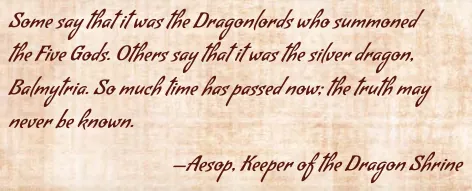
Balmytria’s death ripped a hole in the very fabric of reality that rippled throughout the multiverse. Inspired by her sacrifice, five celestial beings answered her prayer and came to Thylea to protect her people. These beings are known as the Five Gods, who we still worship today: Mytros, Volkan, Pythor, Vallus, and Kyrah.
The Five pledged themselves to protect the civilized races, restoring the balance of power. In the years that followed, an uneasy truce was brokered, creating a peace that has lasted for five hundred years.
In any case, this is how the story is usually told …
The Game of the Gods#
Balmytria saw that unless the Titans were stopped, they would destroy all of Thylea. She vowed action.
Knowing that Sydon and Lutheria were proud creatures, Balmytria challenged the Twins to the game of twenty squares, which is also called the Royal Game. She summoned them to the island of the Golden Heart, which is the home of the Mother Goddess herself. They would play beneath the great tree, with the mother of the Titans as their sacred witness.
The stakes would be simple: she would wager her life and the lives of all her kind against the divine power of the Titans. In this way, the war could be ended.
Lutheria saw the trap right away, but her husband would not listen. Sydon had never been defeated at the Royal Game in all his centuries. He accepted Balmytria’s terms, and the game began.
When gods play the game of twenty squares, the pieces symbolize entire armies, and the fall of the dice are like the hammers of Fate, drenching the earth with the blood of those armies. Thousands of soldiers may live and die by the turn of a single gambit.
Balmytria knew that Sydon had never lost at the Royal Game. Accordingly, she chose her moves with extreme care, taking the full time allotted—one rotation of the stars per turn. And all the while, she was maddeningly silent. Sydon shouted at her, demanding that she look him in the eyes, rise to his taunts, or just say anything at all. He quickly lost patience with the game, rolling the dice as soon as his turns began, simply to have it over with. His impatience proved his undoing.
Balmytria won the first game, shattering the Titan’s winning record and his pride. He raised his fists to the sky and mountains crumbled, so angry was he. But before his sister-wife could calm him, he had doubled the stakes and challenged the silver dragon to a rematch.
This continued for five more games. Balmytria remained patient, neither speaking nor eating even as a full month passed. Meanwhile, Sydon spiraled into a wrath such as the world had never seen.
Lutheria clawed at her own face, furious with her husband’s idiocy. She could not interfere with the game directly, for the magic that enforces the game of twenty squares is woven deep into the fabric of the multiverse.
But she knew that the seventh game was sacred. “Seventh game takes all,” they say. If Sydon could win the seventh game, then the six previous matches would mean nothing. The Titans would have their way.
As her husband lost game after game, Lutheria sat quietly, weaving magic into the dice. Even the greatest spells in Thylea seemed to have no effect. Desperate, she began to pour her divine power into the dice. As the magical energy took hold of the dice, she felt herself growing weaker—and Sydon began to win. No matter how carelessly he threw the dice, they delivered victory. And as the final game drew to a close, it was clear that Balmytria was about to lose everything.
Laughing, arrogant, triumphant, the Twin Titans threw open their mouths and shouted in the face of the silver dragon, “You are nothing. You are nothing.”
But Balmytria only smiled. “I have staked my life on this game, and you have staked your divine power. You gave your divine power to win this game, but now I give my life to match your sacrifice.” With this, she plunged a dagger into her chest, and her blood spilled across the twenty squares, soaking the enchanted dice.
When Balmytria’s blood mixed with the magic of the dice, the fate of the world was forever altered.
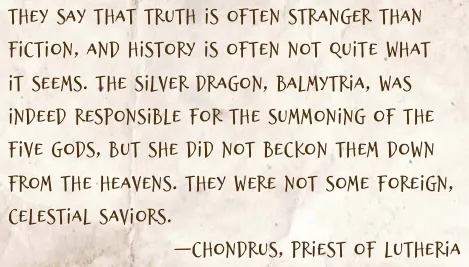
Balmytria knew the dragons could not defeat the immortal Titans unless they became immortals themselves. That was her plan all along. She never intended to kill Sydon and Lutheria, for she knew that the Fates were working against her. Instead, she sought to steal the divine power of the Titans for her own blood.
As Balmytria’s blood drained from her body, the Titans’ divine power replaced it. She ascended into the heavens as Mytros, the Goddess of Dawn. Her husband became Volkan, the God of Forges. Her children became Vallus, the Goddess of Wisdom; Pythor, the God of Battle; Narsus, the God of Beauty; and Kyrah, the Goddess of Music. Together, this new pantheon would turn the tide of the war completely.
History says the dragons are gone, but that is not entirely true. The dragons are still here, but they have been changed into something even greater. Mytros won the war that could not be won by sacrificing herself and ensuring a future for all the mortals of Thylea.
The Oath of Peace#
With the arrival of the Five Gods, the Titans faced an existential threat. They were badly weakened from the fighting of the First War, and much of their divine power had been sapped away. Joined by the power of the Five Gods, the mortal armies were nigh unstoppable.
The Dragonlords made their final voyage into the Forgotten Sea, and great battles were fought over land and water. Eventually, the centaur armies were broken, and the gygan armies were all but exterminated. Sydon and Lutheria had very little left with which they could fight— but they were still gods. Lutheria lay claim to the vast underworld of the Nether Sea, capturing the souls of the dead to make up for what she had lost. Sydon secured his hold on the waters of Thylea, generating great storms that battered the mortal cities into submission. In this way, they forced a stalemate in the war, with the hope that they might recover from their losses.
As the Titans consolidated their remaining power, they struck a revenge blow against the mortal armies. They hunted down and slaughtered most of the remaining Dragonlords, including Estor Arkelander, the captain of the Ultros. The true fate of these brave warriors is largely unrecorded in the histories. In the end, both sides of the war were threatened with total annihilation.
Finally exhausted, the Titans and the Five Gods met once more beneath the great tree of the Golden Heart. They cut their hands and made blood handshakes, agreeing to a solemn truce for five hundred years. This agreement became known as the Oath of Peace, and Mytros, the Goddess of Dawn, sealed the oath with most of her remaining power.
Damon, the great wizard of the Dragonlords, saw it done. He carried the scroll of the oath and the bodies of the fallen Dragonlords back to the city. And then he disappeared into history.