This section contains biographical and statistical information for most of the major characters in the story.
The Five Gods#
The peoples of Thylea believe the Five Gods are outside beings who were called to the land by Balmytria’s sacrifice, but that’s only half the truth. In fact, Balmytria’s death took a different form altogether, stealing divine powers from Sydon and Lutheria through cunning and gifting it to her own bloodline. Five dragons who stood alongside the Dragonlords surrendered their original forms and assumed humanoid identities of gods.
Through the power of their pantheon, they can hear the prayers of their worshippers and provide wonders, charms and blessings. Mytros, through her ascension, is the wellspring of their divine power and the source of priestly magic the Five spread among their priests. For the complete story, refer to appendix E.
Mytros, Goddess of Dawn#
Mytros is the most respected and renowned of the Five, and the namesake of the most important kingdom in Thylea. She is widely credited with the survival of “her” city during the destruction and immediate aftermath of the First War. She is said to appear to her priests as a warrior queen, clad in shimmering golden armor. However, she ascended to the heavens after the cataclysmic battle with Sydon and Lutheria, and she no longer walks among mortals. Mytros is the most powerful of the Five Gods, and the source of most priestly magic among the settler species in Thylea.
Mytros’s True Form#
Mytros came to Thylea as Balmytria, an Ancient Silver
- Dragon. As Balmytria, she was responsible for creating the alliance between her dragon family and the mortal rulers who would become the Dragonlords. She chose to serve as the mount of Xander Huorath, the greatest of the Dragonlords. In her dragon form, Volkan was her husband.
Volkan, God of Forges#
“One of these days, all this warfare will be automated. Bronze soldiers with bronze weapons, and no more bloodshed. That’s my dream, anyway. Let an old man have his dream.”
—Volkan, cranky old blacksmith of Estoria
As one of the Five, Volkan is revered as the forge god of artifice and crafting, and he is primarily worshiped by smiths, masons, and wizards. For centuries, he has been obsessed with crafting wondrous magical items, but he rarely shares these gifts with the rest of the world. In spite of this, many of his greatest works have been scattered across Thylea, and some have even fallen into the hands of his enemies.

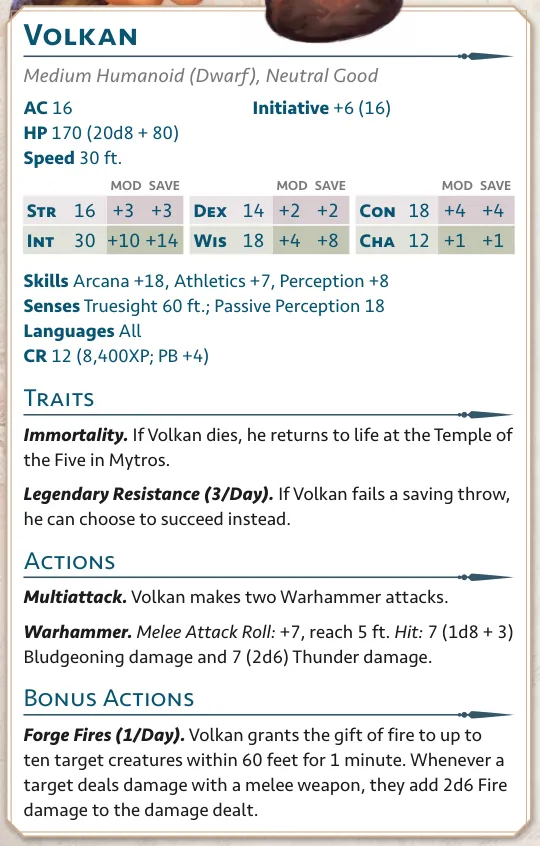
Volkan Medium Humanoid (Dwarf), Neutral Good AC HP 170 (20d8 + 80) Speed Str Int Skills Senses Languages CR 12 (8,400XP; PB +4) Traits Immortality. the Five in Mytros. Legendary Resistance (3/Day). he can choose to succeed instead. Actions Multiattack. Warhammer. Bludgeoning damage and 7 (2d6) Thunder damage. Bonus Actions Forge Fires (1/Day). ten target creatures within 60 feet for 1 minute. Whenever a target deals damage with a melee weapon, they add 2d6 Fire damage to the damage dealt.
16 Initiative +6 (16) 30 ft. MOD SAVE MOD SAVE MOD SAVE 16 +3 +3 Dex 14 +2 +2 Con 18 +4 +4 30 +10 +14 Wis 18 +4 +8 Cha 12 +1 +1 Arcana +18, Athletics +7, Perception +8 Truesight 60 ft.; Passive Perception 18 All If Volkan dies, he returns to life at the Temple of If Volkan fails a saving throw, Volkan makes two Warhammer attacks. Melee Attack Roll: +7, reach 5 ft. Hit: 7 (1d8 + 3) Volkan grants the gift of fire to up to
Volkan appears to be an unassuming, gray-bearded old dwarf clad in a blacksmith’s apron. He is easily (and perhaps deliberately) overlooked by the locals in his home city of Estoria. He was less humble during the First War, when he was known to don a radiant suit of silver platemail, wear a golden crown, and carry a mighty warhammer. These days, he claims his bones ache too much to participate in battles. He prefers to smoke his pipe near the warmth of forge-fires, pondering his next invention.
Volkan’s True Form#
Volkan originally came to Thylea as an Ancient Bronze
- Dragon. In that form, he and Balmytria produced four bronze dragons in the Old World many centuries ago: Kyrah, Pythor, Vallus, and Narsus. Together, the family of dragons became the mounts of the Dragonlords. Volkan had the honor to bond with Rizon Phobas. Volkan cannot transform back into his dragon form until the Oath of Peace (appendix D) ends. As a dragon, Volkan was named Balvolk.
Roleplaying Volkan#
Crafty**.** Volkan is known for devising ingenious strategies. He thinks of the world as a puzzle to be solved, and he often works out problems in his head for days or weeks at a time. He may be gruff and silent for long stretches, only to suddenly appear with some miracle device or solution. The god delights in creation, rather than destruction, and is always intrigued by an intricate new device or stratagem.
Reclusive. Volkan changed after Mytros’ ascension. He was once an affectionate and attentive father, but when he “lost” his wife to her godhood, he grew apart from his children. He eventually came to live almost entirely in his workshop and within his own head. He has also developed a strong affinity for wine, and beer, and mead, and almost any strong drink, all of which he claims inspire his best work.
Kyrah, Goddess of Music#
“I’m told that thousands of songs have been written about me, and bards everywhere pay homage at my shrines. They even call me the Muse. But if that’s the case, then why does no one ever seem to want to read my poetry?”
—Kyrah, Goddess of Music
As one of the Five Gods, Kyrah is revered as the trickster deity of music and poetry. There are very few shrines to her, but bards and poets call upon her for inspiration as “the Muse.” She is the swiftest of all the gods in both thought and deed, capable of disappearing in the blink of an eye and traveling great distances with mere steps. Her mind is equally swift and her voice is said to be more beautiful than any instrument.
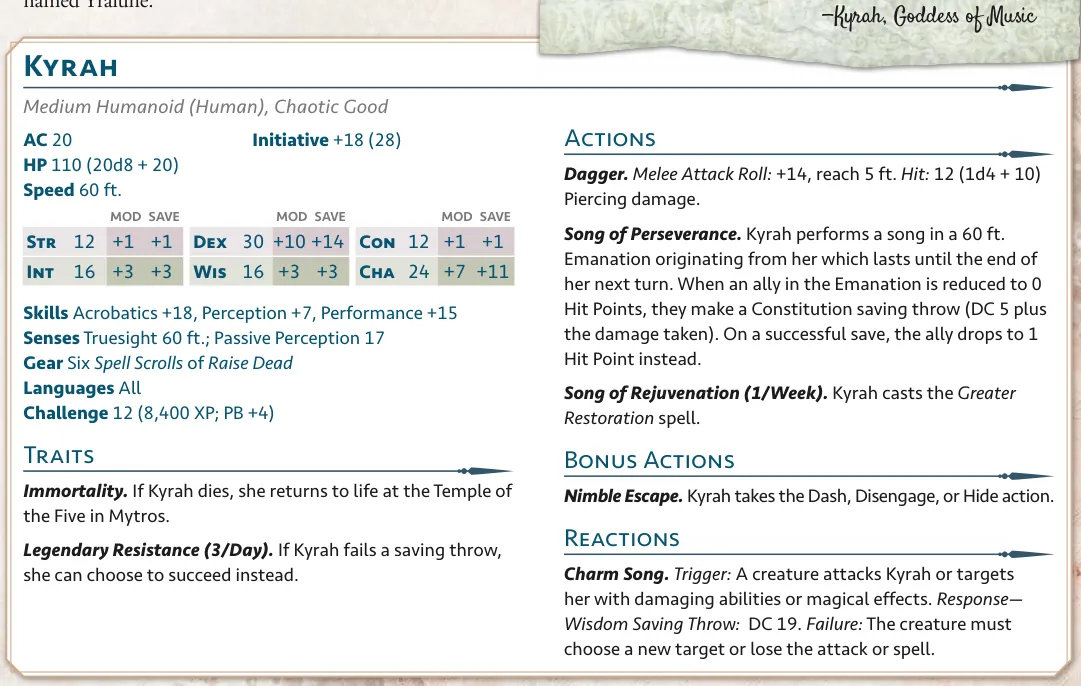
Kyrah Medium Humanoid (Human), Chaotic Good AC 20 Initiative HP 110 (20d8 + 20) Speed 60 ft. MOD SAVE MOD Str 12 +1 +1 Dex 30 +10 +14 Int 16 +3 +3 Wis 16 +3 Skills Acrobatics +18, Perception +7, Performance +15 Senses Truesight 60 ft.; Passive Perception 17 Gear Six Spell Scrolls of Raise Dead Languages All Challenge 12 (8,400 XP; PB +4) Traits Immortality. If Kyrah dies, she returns to life at the Temple of the Five in Mytros. Legendary Resistance (3/Day). If Kyrah fails a saving throw, she can choose to succeed instead.
Actions +18 (28) Dagger. Melee Attack Roll: +14, reach 5 ft. Hit: 12 (1d4 + 10) Piercing damage. SAVE MOD SAVE Song of Perseverance. Kyrah performs a song in a 60 ft. Con 12 +1 +1 Emanation originating from her which lasts until the end of +3 Cha 24 +7 +11 her next turn. When an ally in the Emanation is reduced to 0 Hit Points, they make a Constitution saving throw (DC 5 plus the damage taken). On a successful save, the ally drops to 1 Hit Point instead. Song of Rejuvenation (1/Week). Kyrah casts the Greater Restoration spell. Bonus Actions Nimble Escape. Kyrah takes the Dash, Disengage, or Hide action. Reactions Charm Song. Trigger: A creature attacks Kyrah or targets her with damaging abilities or magical effects. Response— Wisdom Saving Throw: DC 19. Failure: The creature must choose a new target or lose the attack or spell.
Kyrah regularly travels through the Heartlands in the guise of an adventurous bard. She carries dozens of scroll-cases with her, most of which contain terrible poems of her own composition. She can write good ones, but prefers the bad ones because she is so amused by people’s reactions to them. No matter how harsh the critique, she never holds grudges against critics. She serves as the court poet to the Queen of Mytros, her sister Vallus, who finds Kyrah annoying and looks for any excuse to send her away on errands.
Kyrah’s Motivations#
Kyrah wishes above all else to write a great epic poem, something that would make even the Mother Goddess herself laugh and weep. In her search for new material, she is attracted to heroes who perform great deeds, as well as those who are fated to meet terrible ends. She is flirty, witty, clever, and attractive but, for reasons that she never makes clear, will never consent to marry anyone who cannot beat her in a foot race.
Kyrah’s True Form#
Kyrah came to Thylea as a Young Bronze Dragon. She served as the mount for the infamous Dragonlord Estor Arkelander and is still weighed down by shame for the atrocities that he committed while the two of them were oathsworn. Kyrah cannot transform back into her dragon form until the Oath of Peace ends. As a dragon, Kyrah was named Yralune.

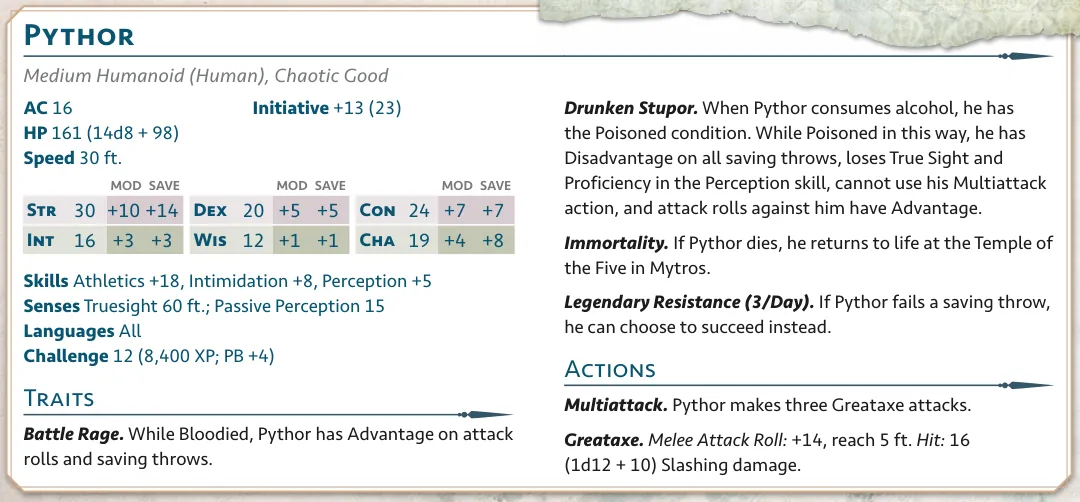
Pythor Medium Humanoid (Human), Chaotic Good AC Initiative 16 HP 161 (14d8 + 98) Speed 30 ft. MOD SAVE MOD Str 30 +10 +14 Dex 20 +5 Int 16 +3 +3 Wis 12 +1 Skills Athletics +18, Intimidation +8, Perception +5 Senses Truesight 60 ft.; Passive Perception 15 Languages All Challenge 12 (8,400 XP; PB +4) Traits Battle Rage. While Bloodied, Pythor has Advantage on attack rolls and saving throws.
Drunken Stupor. +13 (23) When Pythor consumes alcohol, he has the Poisoned condition. While Poisoned in this way, he has Disadvantage on all saving throws, loses True Sight and Proficiency in the Perception skill, cannot use his Multiattack SAVE MOD SAVE +5 Con 24 +7 +7 action, and attack rolls against him have Advantage. +1 Cha 19 +4 +8 Immortality. If Pythor dies, he returns to life at the Temple of the Five in Mytros. Legendary Resistance (3/Day). If Pythor fails a saving throw, he can choose to succeed instead. Actions Multiattack. Pythor makes three Greataxe attacks. Greataxe. Melee Attack Roll: Hit: +14, reach 5 ft. 16 (1d12 + 10) Slashing damage.
Roleplaying Kyrah#
Spirited**.** Kyrah seeks to atone for the sins of Estor Arkelander by doing as much good as possible. She is full of optimistic energy and refuses to stand by when even the slightest injustices go uncorrected and unpunished.
Reckless. Kyrah detests sitting still, and her eagerness for a good story makes her a bit reckless. She will sometimes goad mortals into dangerous acts of heroism, hoping for dramatic material that she can use. However, she never acts maliciously, and she is careful to study prophecies in order to avoid making unreasonable demands.
Mischievous**.** Kyrah loves to play tricks, large and small. Consequently, few people worship her, but nearly everyone believes in her. She is often “credited” when things go missing, or when objects suddenly reappear without explanation. She is especially fond of playing pranks on humorless tyrants and petty bullies, such as King Acastus of Mytros.
Pythor, God of Battle#
“Step aside, sister. If this goes poorly, you can lecture my corpse tomorrow.”
—Pythor, to Vallus, before his first death
at the Battle of Lethe, 17 CE
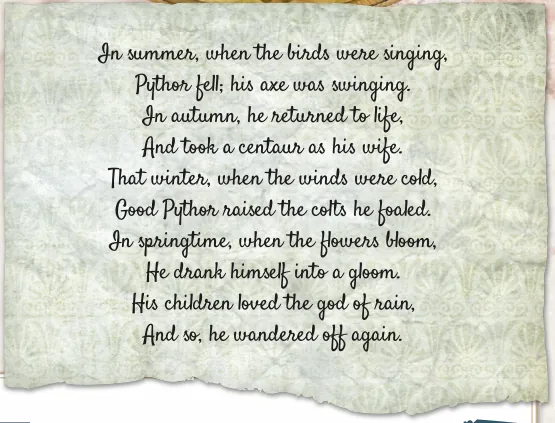
As one of the Five, Pythor is revered as the god of strength and battle. He fought tirelessly in the First War, driving back centaurs and gygans that threatened to overwhelm the city of Mytros. Many songs record his legendary exploits on the battlefield, while many others list his conquests in the bedroom.
In 330 CE, Pythor overthrew the tyrant king Lysis Arkelander and took the throne of Estoria. He has ruled that city as king and god for almost two hundred years
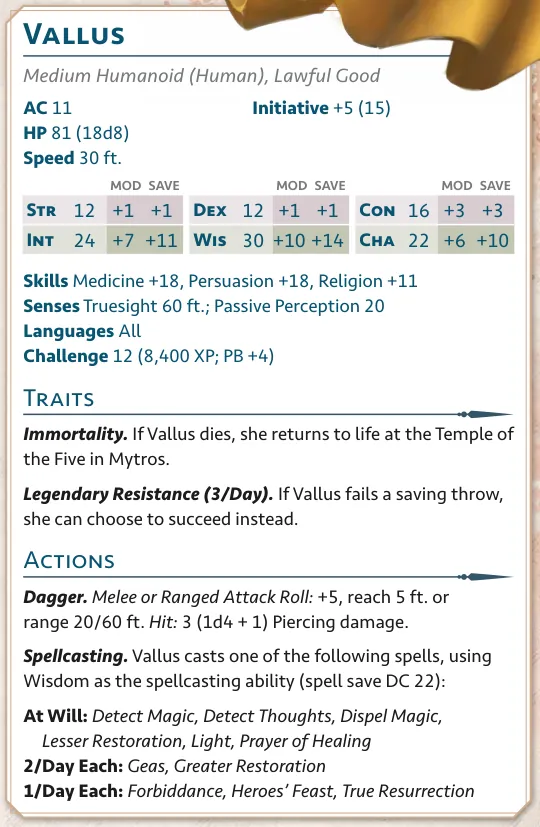
Vallus Medium Humanoid (Human), Lawful Good AC 11 HP 81 (18d8) Speed Str Int Skills Senses Languages Challenge Traits Immortality. the Five in Mytros. Legendary Resistance (3/Day). she can choose to succeed instead. Actions Dagger. range 20/60 ft. Spellcasting. Wisdom as the spellcasting ability (spell save DC 22): At Will: Lesser Restoration, Light, Prayer of Healing 2/Day Each: 1/Day Each:
Initiative +5 (15) 30 ft. MOD SAVE MOD SAVE MOD SAVE 12 +1 +1 Dex 12 +1 +1 Con 16 +3 +3 24 +7 +11 Wis 30 +10 +14 Cha 22 +6 +10 Medicine +18, Persuasion +18, Religion +11 Truesight 60 ft.; Passive Perception 20 All 12 (8,400 XP; PB +4) If Vallus dies, she returns to life at the Temple of If Vallus fails a saving throw, Melee or Ranged Attack Roll: +5, reach 5 ft. or Hit: 3 (1d4 + 1) Piercing damage. Vallus casts one of the following spells, using Detect Magic, Detect Thoughts, Dispel Magic, Geas, Greater Restoration Forbiddance, Heroes’ Feast, True Resurrection
of Wisdom now. His people love him, even though he has been a terrible king, prone to drunkenness and nostalgic ramblings about his past glories. Pythor appears to be a tall, copper-haired man carrying a mithral axe. For centuries, he has walked among the settlers, taking mortals as lovers and fathering countless demigod children. Although he wishes them all well, he takes no responsibility for any of his brood, except one: his favorite daughter, Anora.
Pythor’s True Form#
Before coming to Thylea, Pythor was a Young Bronze
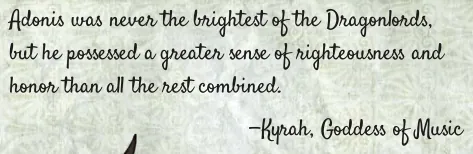
- Dragon. He served the Dragonlord Adonis Neurdagon before the events of the First War. Pythor loved Adonis intently, and he spent decades mourning his death. Pythor cannot transform back into his dragon form until the Oath of Peace (appendix D) ends. As a dragon, Pythor was named Thorpyrax.
Husband of Hexia#
During the time of the Dragonlords, Pythor was married to his adopted sister Hexia, a green dragon. Pythor abandoned his dragon wife when he took on his immortal humanoid form, and she has never forgiven him. Hexia has jealously dedicated her life to destroying Pythor’s happiness and, over the centuries, she has murdered many of his mortal lovers and children.
Roleplaying Pythor#
Amorous**.** Pythor falls in love with literally every beautiful mortal who crosses his path. He just can’t help himself, any more than a moth can help flying towards the candle flame. He is respectful but persistent in his attentions; jubilant in victory and gracious in defeat.
Valorous**.** Pythor is quick to volunteer to fight on the front lines of any battle that he happens across. These days, however, he is more often drunk than sober. He’ll never admit it, but centuries of failure and personal tragedy have taken their toll on his fighting spirit. He believes his glory days are behind him and seeks to drown this fact in a river of wine.
Vallus, Goddess of Wisdom#
“Arrogance may afflict even the very wise. Take it from me … I married Acastus.”
—Vallus, on the subject of Hubris, 487 CE
Vallus is revered as the Goddess of Wisdom. She was once known to travel far and wide, surveying ancient ruins and collecting lore concerning the origins of the land and the fey species. Prayers are offered to Vallus when guidance is needed and information is scarce, and she is believed to know as much about Thylea’s history as Sydon and Lutheria. She is the oldest daughter of Mytros and, in many ways, she has inherited her mother’s place as patron goddess to the city that bears her name.


Vallus works closely with the priests of Mytros to encourage faith in the Five, even as mortals everywhere fall prey to fear of Sydon and Lutheria. She remains a pillar of strength holding the city together as things are beginning to fall apart elsewhere. However, in spite of her best efforts, the citizens of Mytros increasingly offer prayers and sacrifices to the treacherous Titans. Vallus accepts this with grace and humility, and despite her declining power, she will do anything to defend her city.
Queen of Mytros#
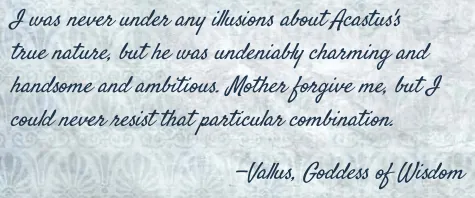
Vallus has one regret: her marriage to King Acastus. Over the centuries, she has been intimate with many beautiful mortals who captured her heart, but her union with Acastus in 478 CE was entirely political. The two have grown to hate each over the years, not least because Acastus makes a point of treating his many infidelities as sport. They have no children, although Acastus probably has many unacknowledged bastards.
Vallus’s True Form#
Vallus was the Young Bronze Dragon who served as a mount for Telamok Arkelander. While Telamok was responsible for almost as many atrocities as his brother Estor, Vallus understands this was part of the cost of settling in Thylea. She is not wracked with the same second-hand guilt that plagues Kyrah. Vallus cannot transform back into her dragon form until the Oath of Peace (appendix D) ends. As a dragon, Vallus was named Vakylux.
Roleplaying Vallus#
Vain**.** Vallus has a reputation for conspicuous vanity. She never allows herself to be seen without exquisite, queenly regalia, and she habitually examines her own reflection in a silver hand mirror. This is partly because she understands the importance of appearances in the world of mortal politics—but she is also vain.
Shrewd**.** Vallus is extraordinarily perceptive, often to the point where she is suspected of mind reading. She always seems to discern truth, even when she is told a clever lie. A hard stare from Vallus is often enough to make even the most skilled liars concede the truth.
Pessimistic**.** Vallus has lost much of her faith in the future of Thylea. Although she endeavors to protect the Temple of the Five in Mytros, she has witnessed too much of Thylean history to believe that the Oracle’s prophecy will result in anything but total disaster.
Mortals#
These are the recurring non-divine NPCs that the heroes come across over the course of the story.
Acastus, King of Mytros#
Acastus Arkelander has been the King of Mytros for over two decades. As husband to the goddess Vallus, he is the most powerful political figure in all Thylea, and the king has a towering ego to match his fame. Although naturally charming, he is not a man who brooks being challenged or overshadowed.
Beneath Acastus outward confidence lies a deep-seated insecurity, because he has accomplished nothing important during his lifetime. He fears death, because he feels that he will quickly be forgotten. He desperately wishes to achieve immortality by increasing his fame so that he will be remembered for many great deeds, like his ancestors.
Acastus has no faith in the Oracle’s prophecy. He is immensely suspicious and jealous of her chosen “heroes” and would rather believe that they are not the answer to his kingdom’s problems. Instead, the king has solutions of his own: he has depended upon the Order of Sydon to maintain peace with the Titans for years, and he plans to rebuild the ancient Order of the Dragonlords with dragon eggs that Lutheria secretly gave him.
Dragon Rider#
King Acastus is one of several famous dragon riders in Mytros. His mount is Icarus, an adult silver dragon who spends his time flying around the city, stealing cattle and over-fishing the waters beyond the harbor. Everyone considers Icarus to be a nuisance, but no one has ever dared to complain to the king. Acastus rides him around the city during festivals to show off his power. The dragon is only an adult because Acastus forced him to age quickly from the egg using Potions of Aging. Icarus still has the callow mind of a wyrmling.
Dragonlord Descendant#
Acastus’s insecurity is made worse due to a connection he has with his ancestor, Estor Arkelander. Estor was the Dragonlord responsible for starting the First War and is now the infamous captain of the ghost ship, the Ultros. Every night Estor whispers in Acastus’s dreams, taunting him for his lack of achievements. The ghost has promised Acastus the immortality that he so desires, but only if he makes himself a willing vessel.
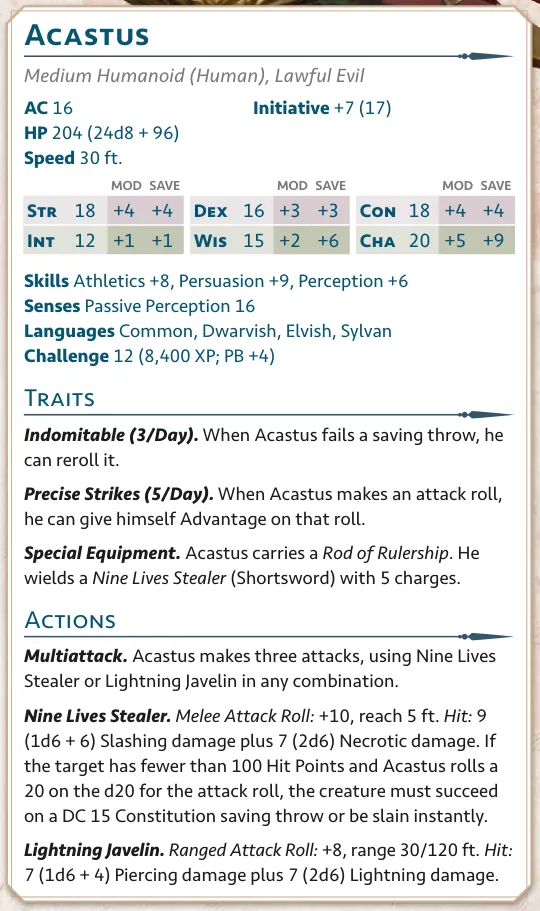
Acastus Medium Humanoid (Human), Lawful Evil AC 16 HP 204 (24d8 + 96) Speed Str Int Skills Senses Languages Challenge Traits Indomitable (3/Day). can reroll it. Precise Strikes (5/Day). he can give himself Advantage on that roll. Special Equipment. wields a Actions Multiattack. Stealer or Lightning Javelin in any combination. Nine Lives Stealer. (1d6 + 6) Slashing damage plus 7 (2d6) Necrotic damage. If the target has fewer than 100 Hit Points and Acastus rolls a 20 on the d20 for the attack roll, the creature must succeed on a DC 15 Constitution saving throw or be slain instantly. Lightning Javelin. 7 (1d6 + 4) Piercing damage plus 7 (2d6) Lightning damage.
Initiative +7 (17) 30 ft. MOD SAVE MOD SAVE MOD SAVE 18 +4 +4 Dex 16 +3 +3 Con 18 +4 +4 12 +1 +1 Wis 15 +2 +6 Cha 20 +5 +9 Athletics +8, Persuasion +9, Perception +6 Passive Perception 16 Common, Dwarvish, Elvish, Sylvan 12 (8,400 XP; PB +4) When Acastus fails a saving throw, he When Acastus makes an attack roll, Acastus carries a Rod of Rulership . He Nine Lives Stealer (Shortsword) with 5 charges. Acastus makes three attacks, using Nine Lives Melee Attack Roll: +10, reach 5 ft. Hit: 9 Ranged Attack Roll: +8, range 30/120 ft. Hit:
Consort of Vallus#
Acastus’s marriage to the goddess Vallus has suffered over the years, mostly thanks to his own pride. He believed that winning the hand of the goddess was a sign of great things to come. Over the years, the romance turned sour as the king’s obsession with fame became clear. Now, the two can barely stand to be in the same room together and view the marriage as a sham. Acastus has brazenly taken consorts that he openly parades before his estranged wife.
Roleplaying Acastus#
Charming. Acastus makes a great show of treating guests well. He conducts himself with apparent grace, humility, and amiable good cheer. His true nature is nearly impossible to discern, even by the most perceptive and suspicious observers.
Faithless**.** Acastus’s loyalties change, sometimes in the space of moments, depending on his understanding of the power balance in Thylea. He is adept at making promises that he never intends to keep, but he’s careful never to swear oaths that would bind him to what might be the losing side in a battle.
Aesop#
Aesop (NG elf Priest) has been the keeper of the Dragon Shrine in Estoria (area E7 in chapter 2) for centuries. He devotes much of his time to studying history, but he also keeps an eye on prophecies, watching for any signs that the Order of the Dragonlords might be restored. He is widely known to be one of the wisest mortals in the land, respected even by Vallus and the Oracle.
Before the arrival of the Dragonlords, Aesop was part of a small tribe of elves who were kept as slaves by the gygans. Most of his tribe were killed during the early years of the First War, but just before the same fate could claim him, Aesop was rescued by Adonis Neurdagon. He never forgot his feelings of gratitude—nor his hatred for the cruelty of the Titans.
Disciple of Adonis#
Aesop was instantly smitten with Adonis Neurdagon. He swore an Oath of Service (appendix D) to the Dragonlord and, over time, the two became lovers. Adonis was famed for his wealth and beauty, as well as his bravery and generosity. He adopted many of the children that he freed from the clutches of the Titans, raising them together with Aesop and creating a dynasty that lasts to this day.
Unfortunately, Adonis’s bravery was ill-founded. He was overconfident in his own abilities and, in spite of Aesop’s repeated begging, he joined the rest of his Order in their last stand against the Titans. Their dragon mounts had disappeared years earlier, forcing them to depend on their own powers and abilities. Without the aid of his dragon, Adonis was killed.
Thereafter, Aesop founded a modest shrine in Estoria to evangelize the Dragonlords and keep records of their accomplishments in Thylea. He left the Neurdagon dynasty in the hands of his children, whose descendants have long forgotten him.
Roleplaying Aesop#
Patient. Aesop lived alongside the original Dragonlords and was keenly aware of their flaws. His expectations for the heroes are high, but he also understands that they will not be perfect. He supports the party’s quest even if they are clearly flawed as individuals.
Focused. Aesop never loses focus on his goal: to restore the Order of the Dragonlords. He will provide whatever support he can to achieve this end. Additionally, he hopes to discover what happened to the original dragons and rescue them in the event that they’ve been captured by the Titans.
Bullbug the Minotaur#
Bullbug is a pot-bellied minotaur (CN Minotaur
- Warrior, appendix B) with a sunny disposition and a penchant for drinking. Contrary to the reputation that minotaurs have in Mytros, he doesn’t have an evil personality or a lust for blood. He has a different view on life than many of his kind because he was raised by a human family who treated him like a son. As a youth, Bullbug gained the distinction of being
one of the few minotaurs to survive the sacrificial rituals in Mytros. He refused to kill the warriors he defeated, and so gained the sympathy of the family matron who took Bullbug into her home and raised him as a son. But then, several years ago, Bullbug’s family were killed by the Order of Sydon, and he was sold into slavery.
Bullbug is not very bright, but he’s loyal and reliable in a fight. He loves to make terrible jokes at the expense of himself and his own species, like blaming especially bad mistakes on his “stupid cow brain.”
Roleplaying Bullbug#
Loyal**.** Bullbug is always true to his word, and he would never dream of breaking an oath. He believes in the power of friendship and family. He will always be there for the people he cares for and for those who care about him.
Hungry**.** Bullbug is always hungry, and he’ll eat just about anything. He often thinks with his stomach, and this gets him into all sorts of trouble since food is not usually free.
Estor Arkelander#
The infamous captain of the ghost ship Ultros, Estor Arkelander has sailed the waters of the Cerulean Gulf for centuries. He and his crew of undead indiscriminately terrorize living sailors and landsmen. Survivors rarely realize the Ultros was responsible
The only thing Estor enjoys more than the terror he causes is the blood he spills. His brother was the Dragonlord Telamok Arkelander, and Estor intensely envied his fame and accomplishments. Throughout Thylea, he and his crew were famed for being fearless warriors who always sought battle: Estor was the very man who started the First War, and who went on to be responsible for many of its bloodiest atrocities.
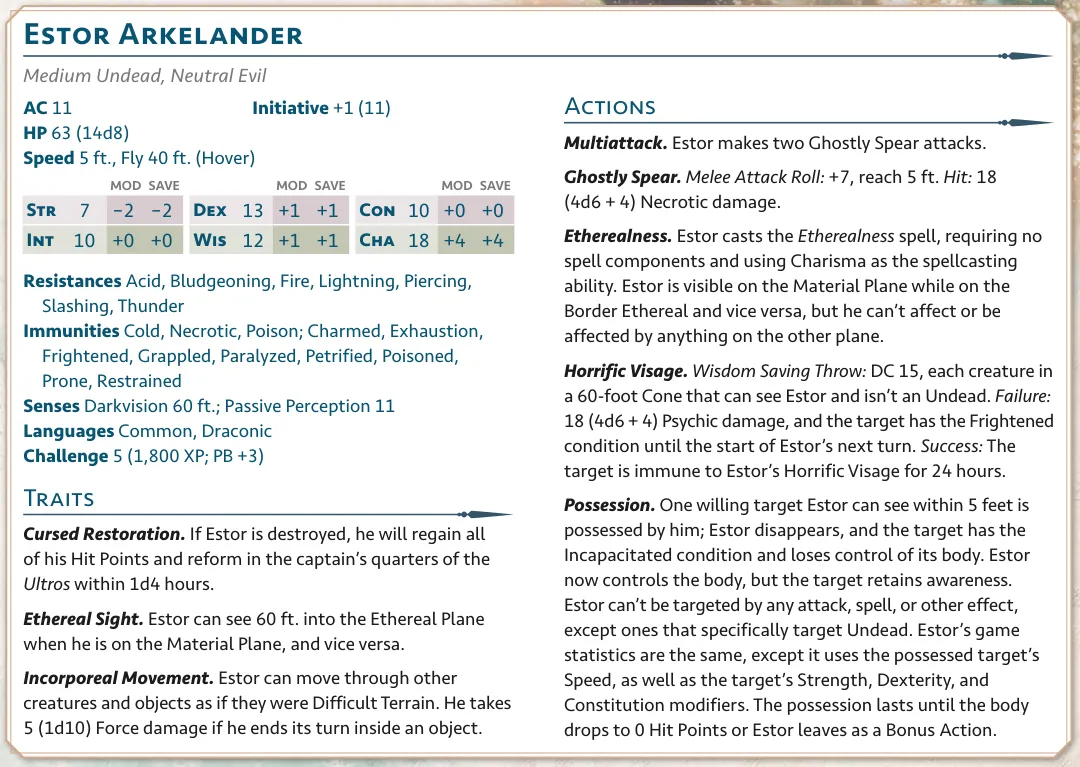
Estor Arkelander Medium Undead, Neutral Evil AC 11 Initiative HP 63 (14d8) Speed 5 ft., Fly 40 ft. (Hover) MOD SAVE MOD Str 7 –2 –2 Dex 13 +1 Int 10 +0 +0 Wis 12 +1 Resistances Acid, Bludgeoning, Fire, Lightning, Piercing, Slashing, Thunder Immunities Cold, Necrotic, Poison; Charmed, Exhaustion, Frightened, Grappled, Paralyzed, Petrified, Poisoned, Prone, Restrained Senses Darkvision 60 ft.; Passive Perception 11 Languages Common, Draconic Challenge 5 (1,800 XP; PB +3) Traits Cursed Restoration. If Estor is destroyed, he will regain all of his Hit Points and reform in the captain’s quarters of the Ultros within 1d4 hours. Ethereal Sight. Estor can see 60 ft. into the Ethereal Plane when he is on the Material Plane, and vice versa. Incorporeal Movement. Estor can move through other creatures and objects as if they were Difficult Terrain. He takes 5 (1d10) Force damage if he ends its turn inside an object.
Actions +1 (11) Multiattack. Estor makes two Ghostly Spear attacks. Ghostly Spear. Melee Attack Roll: +7, reach 5 ft. Hit: 18 SAVE MOD SAVE (4d6 + 4) Necrotic damage. +1 Con 10 +0 +0 Etherealness. Estor casts the Etherealness spell, requiring no +1 Cha 18 +4 +4 spell components and using Charisma as the spellcasting ability. Estor is visible on the Material Plane while on the Border Ethereal and vice versa, but he can’t affect or be affected by anything on the other plane. Horrific Visage. Wisdom Saving Throw: DC 15, each creature in a 60-foot Cone that can see Estor and isn’t an Undead. Failure: 18 (4d6 + 4) Psychic damage, and the target has the Frightened condition until the start of Estor’s next turn. Success: The target is immune to Estor’s Horrific Visage for 24 hours. Possession. One willing target Estor can see within 5 feet is possessed by him; Estor disappears, and the target has the Incapacitated condition and loses control of its body. Estor now controls the body, but the target retains awareness. Estor can’t be targeted by any attack, spell, or other effect, except ones that specifically target Undead. Estor’s game statistics are the same, except it uses the possessed target’s Speed, as well as the target’s Strength, Dexterity, and Constitution modifiers. The possession lasts until the body drops to 0 Hit Points or Estor leaves as a Bonus Action.
Estor searched for fame and more power with increasing urgency as the First War dragged on. Eventually, this led him to take his ship to the fires of Typhon, a mysterious island where he felt that he could gain god-like power. Typhon proved to be a trap set for him by the goddess Lutheria, who tricked Estor into accepting her gift of immortality. She delivered these by turning him and his crew into undead, and cursing them to sail the Cerulean Gulf for all eternity.
Estor was always cruel. His centuries as a ghost, however, have granted him focus: he is still driven by the desire to overshadow his brother, but now he sees a clear path to achieve it, filled with blood. He will take over the life of the greatest of prophesied heroes, then use it to exact brutal revenge against the god who cursed him.
Undying Ambition#
Estor aids the heroes because he feels it will aid in his ambition. By guiding them while on the Ultros, he seeks advantage, hoping their success will grant him vengeance against Lutheria and a path to greater power, even if it means betraying them when the moment serves him best.
Roleplaying Estor#
Hateful**.** Hatred has entirely consumed Estor. Cursed by undeath, he utterly loathes gods—all gods—and their insipid worshipers. He despises weakness in all forms and cares only for power.
Experienced**.** Estor has traveled far and wide throughout Thylea. He knows the secrets and dangers of the Forgotten Sea and the Nether Sea.
Commander Gaius#
Gaius is the Commander of the Order of Sydon. He is a true believer who fervently wants Sydon to rule Thylea. He commands a force of over one thousand knights in Mytros and on the islands of the Cerulean Gulf. In Mytros, he can usually be found at the Temple of Sydon or the Great Palace, but he often travels to the Island of Yonder, where ancient Gygan ruins serve as a military base for his faction.
Dragon Rider#
Gaius travels between Mytros and the Cerulean Gulf with ease thanks to Argyn, his young silver dragon mount. Argyn was raised by Sydon and given to Gaius as a reward for his loyalty. For his part, Gaius loves Argyn and has vowed to marry her when she is old enough to transform into a human. Unfortunately for Gaius, Argyn merely tolerates him. She loves only Sydon, who has promised her a mountain of treasure in exchange for her loyal service to the zealot.
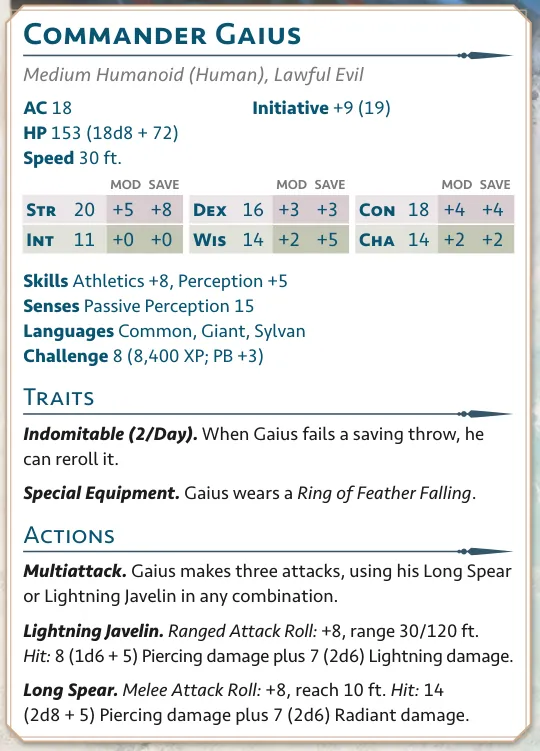
Commander Gaius Medium Humanoid (Human), Lawful Evil AC 18 HP 153 (18d8 + 72) Speed Str Int Skills Senses Languages Challenge Traits Indomitable (2/Day). can reroll it. Special Equipment. Actions Multiattack. or Lightning Javelin in any combination. Lightning Javelin. Hit: 8 (1d6 + 5) Piercing damage plus 7 (2d6) Lightning damage. Long Spear. (2d8 + 5) Piercing damage plus 7 (2d6) Radiant damage.
Initiative +9 (19) 30 ft. MOD SAVE MOD SAVE MOD SAVE 20 +5 +8 Dex 16 +3 +3 Con 18 +4 +4 11 +0 +0 Wis 14 +2 +5 Cha 14 +2 +2 Athletics +8, Perception +5 Passive Perception 15 Common, Giant, Sylvan 8 (8,400 XP; PB +3) When Gaius fails a saving throw, he Gaius wears a Ring of Feather Falling . Gaius makes three attacks, using his Long Spear Ranged Attack Roll: +8, range 30/120 ft. Melee Attack Roll: +8, reach 10 ft. Hit: 14
Roleplaying Gaius#
Zealous**.** Gaius is utterly devoted to Sydon’s cause, and he brooks no insult to the Titans. He spares nothing in punishing what he considers heresy, making (fatal) examples of anyone who threatens the dominion of the Lord of Storms.
Humorless**.** Gaius is dour and grim-faced, and he has absolutely no sense of humor. He crucifies bards just to shut them up. He never drinks. Even his own men are frightened of him.
Loreus the Satyr#
Loreus is a young satyr (CG Satyr) who had a very sheltered upbringing. He is not typical of his kind: rather than frolicking and dallying with nymphs like other satyrs his age, Loreus spends all of his time writing love poems and reading epic romances. He is fascinated by mortal men and women, especially those who resemble the great heroes of his favorite stories.
Roleplaying Loreus#
Lovesick. Loreus will do absolutely anything for the person he loves, no matter how dangerous or embarrassing. He will constantly seek new ways to prove his love, no matter how strange they might look to others, especially if his passion is not reciprocated.
Moxena, The Lady of Coins#
The Lady of Coins is a Medusa from the island of Themis, the twin sister of the current Amazon Queen. Her true name is Moxena, but she abandoned that name after a failed coup against her sister. She rebelled by joining with the Amazon faction who believed that the worship of Lutheria had corrupted their way of life. However, she had no intention of restoring the Amazons to a sisterhood of equals—she just wants to replace her sister as Queen and rule the island herself.
Having fled, she ended up in Mytros. Her political skills enabled her to establish the Cult of the Snake, a thieves’ guild that serves her with unswerving loyalty. She robs from the rich and then uses the money to purchase the freedom of slaves, especially minotaurs, and other undesirables. She is not an altruist, however, as she uses the money and freed allies to build an army to take vengeance on her sister. At the same time, she can easily be convinced to extend her quest to include vengeance against her sister’s patron, Lutheria.

Roleplaying Moxena#
Pragmatic. Moxena may desire revenge against her sister above all things, but she is practical about it. She will seek to form alliances with those who can help her attain that goal.
Prejudiced**.** Moxena dislikes men as a rule and treats them with patient but disdainful condescension. If possible, she will ignore male heroes and speak primarily to female heroes in the party.
Versi the Oracle#
Versi is the daughter of Sydon and a Naiad named Delphea. She is a water nymph (CN Naiad, appendix B) like her mother, but her father’s empyrean blood gave her the power of prophecy. She was born with a third eye at the center of her forehead, which she hides with a golden diadem.
Versi has been known throughout Thylea as “the Oracle” since before the founding of Mytros. She prophesied the coming of the Dragonlords and the birth of the Five Gods. She was also instrumental in forging the Oath of Peace (appendix D), as she negotiated the meeting between the Five Gods and the Titans.
Versi wishes to protect both the mortals and the fey species of Thylea. She once believed that the gods and Titans could coexist peacefully, but she has witnessed too much death and destruction to sustain her optimism. Now, she puts her faith in the heroes, because they represent a chance for the best possible outcome in all her visions of the many possible futures.
Roleplaying Versi#
Haunted**.** Versi is haunted by terrifying visions of the future of Thylea. She clings desperately to the hope that such dark outcomes will not come to pass, but a shadow of fear and doubt is always in her eyes. She knows that the heroes may very well die in their attempt to thwart Sydon and Lutheria.
Possessive**.** Versi thinks of all the mortals of Thylea as beautiful, cherished pets. This is doubly true of those with great destinies. She may choose to follow the heroes and check up on them from time to time, offering much-needed assistance in the way that one might offer treats to a pet dog. She will bristle with obvious jealousy if the heroes become too close to or dependent on other fey creatures or gods.