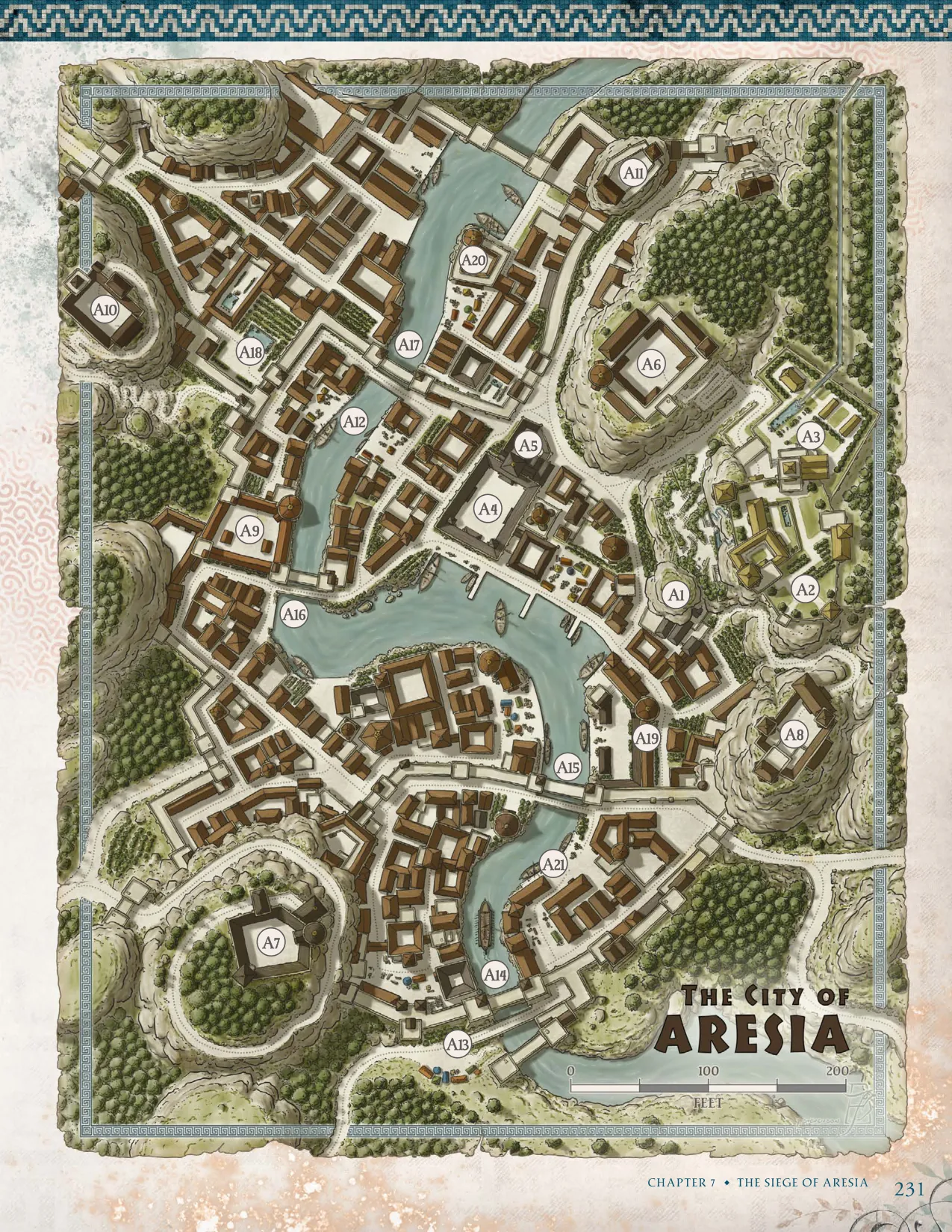
The city of Aresia is the largest settlement in the Aresian peninsula. It’s famed for its martial arts temples, impressive walls, and hanging gardens. Located in the midst of a dense forest of spruce trees, the city is accessible from the Cerulean Gulf via the Thrake river. The city’s walls are the pride of its citizens. They reach 100 feet in height, so that the ramparts overlook the forest canopy.
The river cuts through the center of the city via a system of gates that can be raised and lowered. The gates are wide enough to accommodate one full sized trireme at a time. Aresia does not have a navy, so there are rarely many ships within the city except for the traders who ferry goods for the Aresian markets.
The city is home to the famed Aresian warrior monks, who wear red cloaks and bronze helmets, fighting with spears and shields. They have a centuries-long grudge against the armies of Mytros, with open warfare breaking out between the two cities every few decades. The most beautiful feature of the city is its hanging gardens. The gardens are watered by a system of channels that carry water from the Thrake river. At the top of the gardens is the palace where the queen lives.
Centuries ago, the first queen of Aresia captured Narsus, the god of beauty, and her successors have held him prisoner there ever since.
Aresian Factions#
Aresian society is centered around the ruling queen, who also serves as high priestess of the Temple of Narsus. Aresian entertainment revolves around competitions between the city’s martial monasteries.
The Queen of Aresia#
For the past 500 years, a queen has ruled Aresia. The Founding Queen was named Calliope, and she is famous for bringing Narsus to Aresia. She lured him here under false pretenses, but he has never truly been a prisoner, like the stories in Mytros suggest. Narsus is a lazy and vain god, so he isn’t in any hurry to leave.
The current queen is Helen. She closely monitors the affairs of her palace and the Temple of Narsus, and she makes the final judgments concerning the city’s future. However, she leaves most of the tiresome governing to her council of advisors. There was only ever one King of Aresia—Karpathos, the father of Calliope. His history
was carefully buried. From Calliope’s reign onward, there was never another male monarch. The queens take male consorts, but no queen would suffer a king to be revered above Narsus.
Monastic Temples#
Aresia is a city devoted to martial perfection. From childhood, every citizen is shaped by the five great temples and the six fighting styles they uphold. Four styles the Way of the Elements, the Way of the Sword, the Way of the Shadow, and the Way of the Shield are each practiced in temples dedicated to their philosophy. The Temple of Tranquility alone teaches two disciplines, guiding students in both the Way of Tranquility and the Way of the Open Hand.
These temples do not merely coexist; they compete. Each week, their disciples clash in public trials, displaying technique before roaring crowds. Aresians grow up pledging loyalty to a temple and celebrating its victories. For many, these rivalries matter as much as war, for honor is claimed not on battlefields, but in the ring. The Way of the Shield has dominated for years, but nothing remains unchallenged forever.
Narsus, God of Beauty#
Narsus is the city’s beloved god of beauty, vain to the core and indulgent in every pleasure. Five centuries ago, Queen Calliope constructed the Chamber of Beauty beneath the Temple of the Shield to pamper him, trusting that his laziness would keep him there forever.
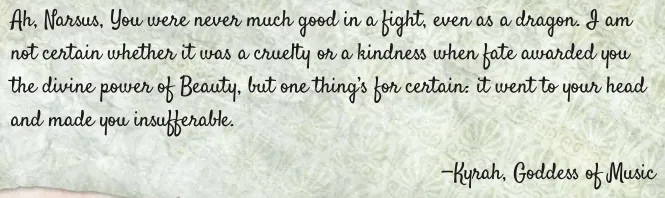
Like the Five Gods of Mytros, Narsus was once a bronze dragon elevated to godhood at the dawn of the Oath of Peace. When the Oath ended, he was stripped of divinity and forced back into draconic form. His pride cannot endure this humiliation, and so he quietly seeks a way to regain godhood.
Aresian History#
Aresia was founded before the First War. There is a long history of tension between Mytros and Aresia.
Founding of the Royal House#
The royal house of Aresia was founded by King Karpathos and Queen Nemosyne, five hundred years ago. Together, they swore an oath to fight for Lutheria in the First War. However, they failed to appear when she needed them most, and she named them oathbreakers. As punishment, Lutheria cursed the king and queen to undeath, transforming them into vampires.
The entire royal family was consumed by the curse, with the exception of one daughter, named Calliope. Karpathos and his wife made their lair in a tomb near Aresia, hunting by night and preying on the people of the city. Calliope rallied her warriors and trapped her parents and their vampire spawn in the tomb.
Thereafter, Calliope took the mantle of queen and sought peace with Mytros to atone for her parents’ treachery. But then, during one of her diplomatic visits, she became enamored with Narsus and absconded with him, causing a permanent rift between the two cities.
The Aresian Campaigns#
In the past 500 years, there have been at least twelve wars between Aresia and Mytros. This number varies depending on which historian one consults: each city claims victory in at least seven of the wars. The Aresians frequently boast that no siege has ever successfully breached their walls—and this is true, but they have often been crushed on the battlefield by the phalanxes of Mytros. On the other hand, Mytros boasts that their armies are unstoppable on the battlefield—but the warrior monks of Aresia have repeatedly razed entire districts of Mytros to the ground.
In spite of this long-standing rivalry, the two cities depend on trade with one another, and fleets of merchant ships regularly carry goods from one city to the other.
Exploring Aresia#
If the heroes explore Aresia during their explorations of the Cerulean Gulf in chapter 2, you can use the Rumors in Aresia table. However, if the heroes enter Aresia during the siege, all talk will be about the war.
The Random Encounters in Aresia table can be used to generate encounters in either scenario.
Narsus#
Long ago, Narsus , the God of Beauty, abandoned his siblings and sought an easy life among the mortals of Mytros. Almost every woman he met wanted to marry him, so he decided to make a game out of it. He proposed a contest to kill a white stag**,** offering his hand to whoever succeeded at the seemingly impossible task.
Most contenders gave up the hunt after the first year, but the oread huntress, Ekoh, was obsessed with Narsus. She spent years searching for the stag and finally killed it. Triumphant, she returned to Mytros to claim the god’s hand in marriage—but she was too late.
Queen Calliope of Aresia had seduced Narsus, luring him away to Aresia, where he’s been kept ever since. Ekoh was furious that Calliope had violated the rules of the contest, and has been trying for centuries to reclaim him. This is why Narsus must be kept hidden—and why the walls of Aresia grew to 100 feet in height.
A2: The Queen’s Palace#
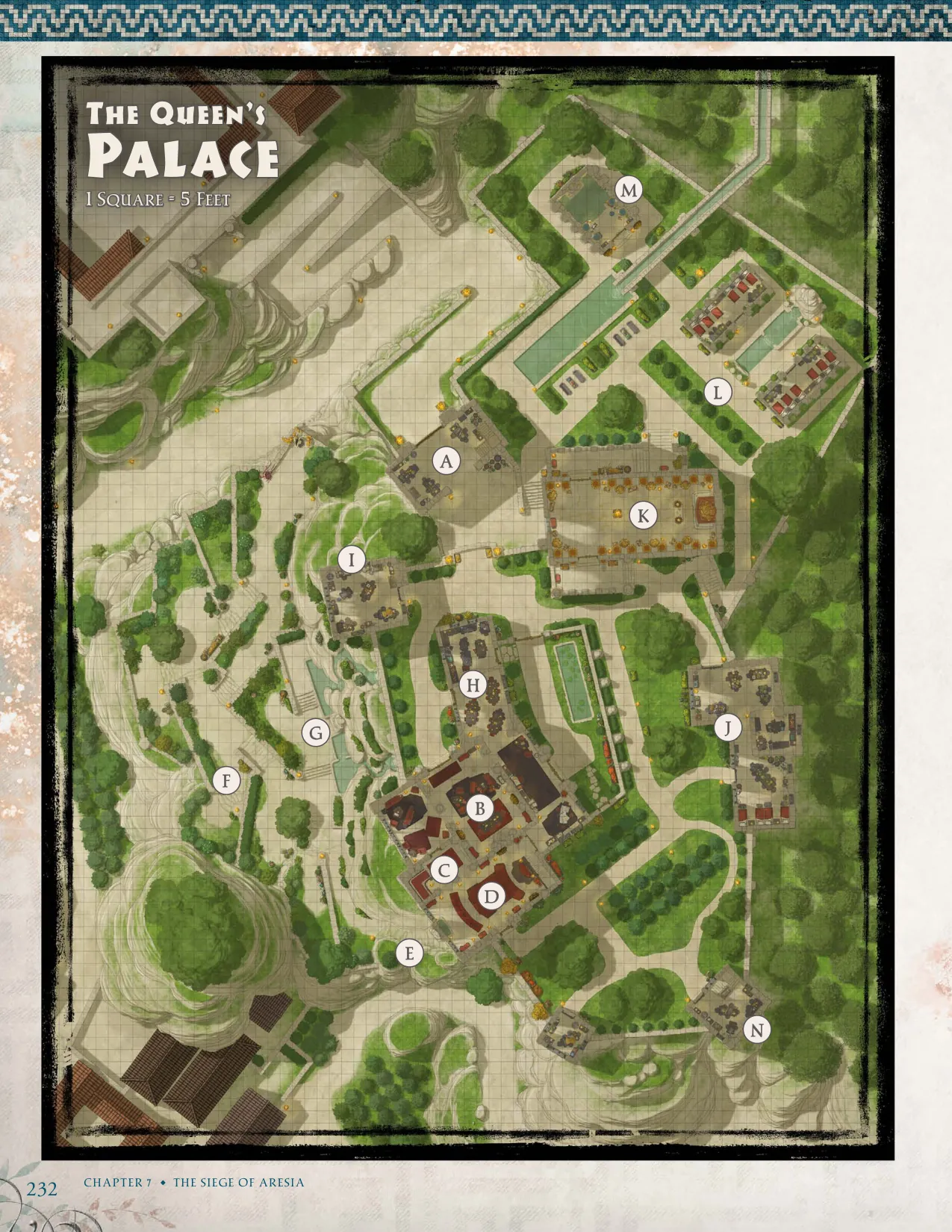
The grounds include several buildings: the main palace, the bathhouse, and the surrounding guard towers. Near the rear of the grounds are the guards’ barracks and the servants’ quarters. The barracks house the queen’s legion of royal guards who wear distinctive crimson velvet cloaks trimmed in gold.
Queen Helen (NG Noble) serves as ruler of the city and high priestess of the Temple of Narsus. She can be found in her throne room (area A2B) during formal functions, and her bedchambers in area A2D when off duty. The queen is never seen in public without an entourage of young, handsome guards.
Details of the palace are described below.
A2a: Palace Gates#
The gates of the palace are made from bronze. They are barred from the inside. The gates have AC 18, 200 Hit Points, and Immunity to Poison and Psychic damage. There are four Aresian Monks (appendix B) stationed inside the gates at all times.
Key Locations in Aresia#
The City Walls#
The city walls are constantly patrolled by hundreds of
- Soldiers (appendix B) and Aresian Monks (appendix B), who rotate between the different gates throughout the day. The walls are 100 feet high and constructed with heavily fortified stone masonry that has been painted white. To reach the top of the walls, guards must climb spiraling stairways accessed from the interior side of each gate.
A1: Hanging Gardens#
The gardens are visible from almost anywhere in the city, and many upper class Aresians pass long hours beneath the lush, exotic vegetation. For more details on the Hanging Gardens, refer to area A2F in the Queen’s Palace.

This marble chamber houses a magical artifact called the Palladium (appendix C). So long as it is housed within the palace, all siege weapons defending the city have Advantage on attacks, and the walls of the city have resistance to damage. This artifact is the reason why the armies of Mytros have never breached the walls of Aresia.
Treasure**.** In addition to the Palladium, the treasury contains the following:
Gem-studded Masks (20). Crafted of silver, gold, and electrum, each worth 1,000 GP. They depict former queens, generals, and champions of Aresia.
Adamantine Chest. Locked and reinforced, requiring a DC 25 Dexterity check with thieves’ tools to open. Inside are 25,000 GP in neatly stacked coinage.
A2c: Stairs to Gardens#
These stairs descend to the Hanging Gardens (area A2E). Aresian nobles that are in favor with the queen are allowed into the gardens. One Aresian Monk (appendix B) stands guard here.
A2d: Queen’s Residence#
The three Monk Masters (appendix B) on guard are vigilant and will challenge anyone not accompanied by the queen. Behind them, the stairwell climbs nearly one hundred feet, ascending through a tower to the queen’s private bedchambers above.
Queen’s Bedchambers**.** Read the following when the heroes enter the room.
The queen’s chamber is one of the most lavish in the known world.
A2b: The Throne Room#
There are four Monk Masters (appendix B) in the throne room at all times. There is a 1 in 4 chance that Queen Helen is here.
The Palace Treasury. A stairwell is accessible beneath the white dais of the throne room. It leads to the basement of the palace where the treasury is located. A magical command word, known only to the queen, will cause the throne to slide to one side and reveal the stairs. Alternatively, a successful DC 25 Strength (Athletics) check will allow the throne to be pushed to one side.
Two crimson-cloaked Monk Masters (appendix B) stand watch here at all hours. They are sworn to fight to the death before allowing anything to be taken.
A2e: Stairs to Palace#
These stairs ascend to the Palace (area A2C).
A2f: Hanging Garden Paths#
The gardens are considered the most beautiful in Thylea.
Enchanted Olive Grove**.** The olives here can be harvested daily. Each olive begins the day as a fresh green fruit, but it ripens to a rich purple near sunset. Legend has it that these unique olive trees were gifted to the Aresian settlers by centaur druids before the First War, and they are sacred trees of the Mother Goddess.
The Gardeners**.** The gardeners are led by a handsome stoic named Diocletes (NG centaur Druid). He and his team are forbidden to speak on the job. This is a rule long enforced by the nobility, who wish for a quiet place to gather and gossip. Diocletes stands a full head above his team, and the queen often admires him from her palace balcony on clear days.
Correspondence**.** The writing desk is strewn with sealed writs and personal correspondence. Amongst these is a letter from Halcyon, grandmaster of the Temple of the Shield, politely requesting additional funds to supply the temple’s subterranean larder for Narsus. The ledger tucked beneath the letter lists weekly deliveries and a standing stipend of 5,000 GP per month.
Trapdoor**.** Beneath the bed a finely hidden trapdoor leads to the Temple of the Shadow tunnels. Spotting the seam requires a successful DC 15 Wisdom (Perception) check.
Treasure**.** Many items such as paintings and marble statues are too heavy to pilfer. However, the following items can easily be stolen: an emerald circlet set with small pearls (worth 2,000 GP), a gold signet ring bearing the royal crest (worth 500 GP); a velvet casket with 650 PP in coin, and three vials of perfume labeled “Narsus” (worth 50 GP each).
Leandros. Leandros, commander of the Queen’s Guard, is the oldest among them. Scarred, solemn, and nearly two decades senior to his men, he has never lost a tournament match. Though he no longer competes, his reputation and discipline command absolute respect. His loyalty to Helen is unquestionable, and some whisper that it runs deeper than duty.
A2k: Temple of Narsus Interior#
This temple is full of mirrors, and it has ceilings covered in gold leaf. Despite its name, Narsus rarely comes here. The temple primarily serves as a convent for his priestesses. The priestesses of the temple (LG Priest Acolytes) are selected at age 12 for their loyalty to the queen, and they serve for twelve years, retiring at the age of 24. They wear silky gowns and scarves wrapped to conceal everything except their eyes—the queen brooks no competition for the affection of the God of Beauty.
A2l: Statue of Calliope and Narsus#
An inscription carved into the base of the statue reads as follows:
A2g: Statue of Queen Calliope’s Coronation#
An inscription carved into the base of the statue reads as follows:
A2h: Kitchens#
These rooms are used to prepare meals for Queen Helen and the other residents of the complex. Two servants (LN
- Commoners) are on duty here at all times.
A2i: Servant’s Quarters#
Three servants (LN Commoners) move about their duties, sorting linens and polishing boots. They freeze at unfamiliar faces and exchange worried glances. None will challenge intruders, though one will attempt to slip away to fetch one of the queen’s guards.
A2j: Guard Barracks#
These barracks house the queen’s royal guards. The barracks reflect Aresian ideals. Junior guards, still proving themselves, are quartered on the upper floors in well-appointed rooms overlooking the gardens and training grounds. Veterans live below, in austere underground chambers that reinforce the city’s reverence for humility and endurance.
There are usually a four Aresian Monks (appendix B) on the main floor with another three on the top floor, along with Leandros in the basement.
A2m: Bath House#
Three handsome male attendants (LN Commoners) tend to oils, towels, and heated water. They greet guests politely, but any unfamiliar intruders prompt hushed whispers and as soon as they are alone, they quickly alert the nearest royal guard.
A2n: Guard Towers#
Each tower rises 120 feet, offering an unbroken view of the palace grounds. Two Aresian Monks (appendix B) remain stationed in every tower at all times. At the first sign of trouble, they strike a bronze gong, a single note that summons every guard within the grounds.
A3: Temple of Narsus#
This is the Temple of Narsus and the most opulent building in the city. The people of Aresia believe that Narsus loves their city and blesses them with his presence. Accordingly, the servants attend to his every need, day and night.
For more information on the temple, refer to area A2K.
A4: The Gymnasium#
This is one of the most famous structures in Aresia—and the most highly trafficked. It contains rows of stands for thousands of spectators, and an open central arena covered in sand. During the week, warriors come here to train on weightlifting equipment, but it gets cleared away on weekends for events and tournaments.
Aresian Tournaments**.** The biggest tournament happens each week on seventhday, when most of the city shuts down and fills the stands. There are also facilities for bathing and grooming, and warriors in the arena take great care to oil their bodies and display their muscles to perfection.
Daily Demonstrations**.** While the secrets of each martial discipline are confined to their temples, the gymnasium is where warriors train when they wish to be seen. Even on training days, there are delighted onlookers in the stands, whether aspiring young warriors or older Aresians admiring the beauty of the human form. The events are as follows:
Armed Combat. The most popular and competitive event by far, armed combat is dominated by warriors from the Temple of the Shield. Most events showcase their expertise in the shield-and-spear techniques. Tournament regulations require spears and other weapons to be blunted to minimize injuries, but events are often bloody regardless. There are also champions from other disciplines, including the Temple of the Sword. Warriors from the Temple of Tranquility are famous for taking down armed opponents with simple weapons, such as slings.
Boxing. The Temple of Tranquility often dominates this event, which rewards speed and solid footwork. Competitors wrap their fists with linens and compete to knock each other out. The event uses a raised boxing ring, and this is the only event where spectators are allowed on the sands.
Wrestling. This event focuses on unarmed techniques. Fought on mats, competitors follow strict rules while trying to force their opponents to the ground to surrender. During this event, warriors develop colorful personas and complex storylines, much to the delight of children in the city.
Shot Put. The least popular of all the events, shot put competitors throw heavy stones and occasionally hammers. The goal is to launch them as far as possible. In the past, the Temple of the Elements won too many trophies in this event using secret techniques, so they are currently banned from participating.
A5: The Sanctuary#
This sanctuary is attached to the Gymnasium (area A4). It includes a small shrine for praying to the gods and an infirmary where warriors can recover from injuries. The shrine is the domed building attached to the gymnasium to the southeast, and the infirmary includes the buildings to the north and east.
The Infirmary. Many warriors need healing after events and tournaments at the Gymnasium. The head priest here, Lennicus (NE dwarf Priest), gambles on the events, and is it rumored that he makes a tidy profit. He goes by the name “Lenny,” and he considers it his job to patch up competitors—rather than coddle them—so they can get back into the fight as quickly as possible.
Shrine of Luck. This shrine offers services including healing and other priestly spells. It houses statues of each of the Gods and Titans—competitors come here to pray “for luck.” However, it is clear which gods are favored, as Thylea’s statue is draped with garlands, and Pythor’s is caked with red paint. Narsus’s statue is the most elegant of all, shimmering in gold leaf and surrounded by flowers. Kyrah’s statue has some offerings (including small paintings and music scrolls), but the statues of Mytros and Vallus are falling into disrepair.
A6: Temple of the Shield#
This temple teaches the legendary Aresian fighting style, the Way of the Shield. This is the most prestigious martial arts temple in the city, and masters here teach techniques that have long challenged the fearsome phalanxes of Mytros. The school’s reputation is well-earned; this is a highly regimented and organized temple where everything is polished to a spit-shine.
As the strictest of the Aresian temples, discipline here is a top priority. In order to maintain the image of the temple, those perceived as soft and slovenly are routinely culled, no matter how impressive their past achievements may be. The temple’s proximity to the queen is a symbol of its importance, as their warriors guard the chamber of Narsus himself, located deep within the hill beneath their temple.
Grandmaster of the Shield. Halcyon (LG human
- Monk Grandmaster, appendix B) reigns as Grandmaster of the Shield. She is hyper-competitive, and extremely tough on her students. She expects the absolute best at all times—from others and herself. She has mothered many sons and daughters who are now elite warriors at the Temple of the Shield. Halcyon has been hard on them, and several of them are resentful. But she wants her warriors to make the queen proud—many are eventually selected to join the royal guard. Chamber of Beauty. Located beneath the temple, there
is a winding series of caverns concealed within the depths of the hill. This is where Narsus (CN Adult Bronze
- Dragon) resides, attended to by his priestesses and Pyrrha (CN Siren Spellsinger, appendix B). The outer chambers are guarded by ten Aresian Monks (appendix B), but they are never permitted to enter his chambers. Few besides the priestesses have laid eyes on Narsus in recent years, and the warriors posted here consider it a kind of punishment. Siren Attendant. Pyrrha is a siren who sings day and
night for Narsus. Queen Helen is intensely jealous of her and has attempted many schemes to get her sent away. However, Narsus is soothed by her singing voice, and
refuses to let her leave. Pyrrha is deeply in love with Narsus, but all he’s ever said in return is how much he loves her songs. There are whispers that Pyrrha possesses a map to the long lost kingdom of the sirens.
Meeting Narsus. Whenever the party meets Narsus for the first time, refer to the Audience with Narsus section for narration text and details.
A7: Temple of Tranquility#
This temple teaches both the Tranquility and Open Hand monastic traditions. Reaching the temple requires a strenuous hike, but the master here claims that this long walk facilitates contemplation. Younger monks who train at this temple are expected to spend years gathering olives before they are taught any martial techniques. There is a joke among the younger monks that the real lesson of the school is patience, as the master only seems to train those who have turned gray and wrinkled with age. It is no surprise, then, why this school has the highest drop-out rate of any temple in Aresia.
Grandmaster of Tranquility. Laertes (NG human
- Monk Grandmaster, appendix B) has served as Grandmaster of Tranquility for longer than anyone can remember. He is a wizened old man with a seemingly impossible number of wrinkles and a long, braided white beard. While he never states his age, there is speculation that he is at least 500 years old. Laertes famously subsists on a single olive per day,
and most of his day is an elaborately constructed ritual around this single olive. Most of the monks-in-training spend hours walking across the city to the enchanted olive grove, where they pick a single ripe olive at dusk. They must then walk all the way back to present their olives before Laertes, who goes through a lengthy ritual to select a single olive to eat. Laertes rarely speaks, but the monks closest to him believe that he is on the quest to find the perfect olive, and he refuses to die until he’s enjoyed it.

Many aspiring monks leave the school in frustration, but veteran students profess the wisdom of Laertes: that patience is the key to enlightenment.
A8: Temple of the Shadow#
The most secretive of all the temples, this school teaches the monastic tradition called the Way of Shadow. Their members are trained to become spies and assassins, and they often serve as secret police for the queen. They move in the shadows, and their exact numbers are unknown. It is believed that they also have agents in Mytros, to keep an eye on their rival city.
Cult of Lutheria. It is a closely guarded secret that students of this temple worship Lutheria. They keep several shrines to the Mistress of Death. At any given time, there are at least three captives here being tortured for information. The queens of Aresia have long suspected this, but they turn a blind eye to it.
Grandmaster of the Shadow. The Grandmaster here is called the Shadow Master, and no one knows her identity, not even her own students. The Shadow Master disguises herself as a jovial innkeeper at the tavern named Jocasta, (LE elf Assassin). This plump elf woman has been the city’s spymaster for 500 years, and her loyalty to the throne is waning. She’s grown tired of the capricious, selfish queen.
The Shadow Master’s Plot. If the heroes ask questions about Narsus while in Aresia, it is likely that one of Jocasta’s spies will notice this and bring them to the Shadow Master’s attention. Jocasta will meet with the heroes and try to strike a deal. She knows where they can find Narsus, but in exchange for that information, she would like them to help her kill the Queen.
A9: Temple of the Elements#
This temple teaches the monastic tradition called the Way of the Four Elements. They focus on elemental techniques to control air, water, earth, and fire. Unlike the other temples, the students here are less combat focused and instead help with the marketplace and city maintenance. Water and earth specialists help ensure that the marketplace runs smoothly and assist with stocking and boat traffic. Many of the monks are tasked with management of the city’s
vital utilities, including the aqueducts, the masonry, lighting and dousing the torches, and more. While elemental monks are not highly respected as warriors in Aresia, they are seen as vital to the city’s day-to-day operations.
Grandmaster of the Elements. An imposing presence, Taureus (NG Grandmaster Monk, appendix B) serves as Grandmaster of the Elements. Tall and broad even by minotaur standards, Taureus is jovial but has a keen business sense. While he is trained in the Way of the Four Elements, he mostly works as a master merchant, overseeing the bazaar and keeping a watchful eye out for smugglers.
Master of Ceremonies. Taureus also serves as master of ceremonies at the gymnasium, as his booming voice can be heard from even the highest seats. He specializes in earth-manipulation techniques, and his decade-long winning streak in shot put is the reason why elemental monks have been banned from the event.
Proud Minotaur. Taureus has no love for the people of Mytros, because they keep his people as slaves. If he learns that one of the heroes is from Mytros, he will demand to know where they stand on the issue.
A10: The Tower of Wind#
This shrine serves as a base for the 1,000 Scouts who patrol the woods beyond Aresia. The general here shares command of the scouts with the Temple of the Sword (area A11). The chimes serve as an indicator of robust trade winds, and those stationed here must grow accustomed to the constant jangling of chimes. When the chimes grow quiet, it usually signals the calm before a storm.
The Horn of War. The shrine houses a large bronze horn that is used to recall scouts from the wilderness. When the horn blows twice, the keepers of the aqueducts seal the river gates. When the horn blows thrice, all the warriors of Aresia scramble to their posts and line the walls with their spears. No one knows what four blasts would mean. The horn was gifted to the city by Sydon, and it is held in place by a large statue of the storm titan. Sailors often visit this statue to pay their respects before setting out on long voyages.
The General. As commander of a thousand scouts scattered in the wilderness, General Niobe (LN Gladiator) has one of the hardest jobs in the city. While she takes pride in her work, decades on the job have taken their toll on her. She is mostly deaf from years stationed in the Wind Shrine, and the one thing she looks forward to each week are the tournaments.
Playing Matchmaker. Niobe has a longstanding crush on Hiero, Grandmaster of the Temple of the Sword (area A11), a reserved man with whom she’s worked intimately for decades. She asks him to marry her each year, but he refuses, claiming that he cannot marry until his honor is restored. If the party is interested in helping her, then they should speak to Hiero.
A11: Temple of the Sword#
This temple is responsible for guarding the two northern gates of the city, both land and river. This is the smallest martial temple, having no formal recruitment process. The masters here emphasize self-discipline and training in total silence. They follow the stoic philosophy of showing humility before the gods, focusing on doing good work—and most importantly, not complaining or asking for more. While the shield enforce discipline with an iron hand, sword monks are expected to develop it naturally. The masters only draw their sword monks when they intend to cut the enemy.
Grandmaster of the Sword. Grandmaster Hiero (LG, half-elf Grandmaster Monk, appendix B) never sought to be a leader. He earned his title after many battles against the armies of Mytros. During one such battle, Hiero won an ancient Mithral Honorblade (appendix C), and for years he believed that he was worthy of the sword.
Returning the Blade. Recently, Hiero was defeated in a duel by the mad warlord, Zakroth, who severed his right arm and claimed the honorblade as a trophy. Hiero has lived all his life as a stoic—he accepts his failure, but it has left him just a shadow of his former self. If the party returns the blade to him, then he will be deeply moved, and he will finally agree to marry Niobe (area A10).
A12: The Market#
The market is open every day except for seventhday, widely known as Tournament Day. Aspiring artists are often seen on Ram’s Gate and in the street, hoping to catch the eye of wealthy merchant patrons.
As the chief source of olives and olive oil, Aresia offers them at a bargain and sells many olive-themed treats and goods for tourists. Many of the imported goods come from Mytros—everything from wine to metals, cloth, and dry goods. Occasionally, the market draws protesters who claim that many Mytrosian goods are made with slave labor, but most turn a blind eye, as both cities depend on a healthy trade relationship.
A12A: Elie’s Olive Emporium#
Renowned across Thylea, Elie’s is the destination for olives. Catering to tourists and locals alike, there is an olive here for even the most discriminating connoisseur. Elie (NG human Noble) is charming and polite to tourists, but she charges them double the usual rates, unless they have performed some great service for the city.
The Perfect Olive. If asked about the ‘perfect olive’, Elie says that the peninsula’s centaur druids supposedly know the secret to cultivating the perfect olive. Agrius, the King of the Centaurs, is rumored to possess the legendary seeds of the perfect olive tree.
A12D: Haidee’s Curiosities#
This shop is run by Haidee (NG halfling Mage), who studied at the Academy in Mytros. After hearing of Narsus’ beauty, she decided to make the journey to Aresia. However, in the time since she arrived, he has never once made an appearance in public. Haidee keeps her magical goods in a Bag of Holding.
A13: City Gates#
There are four routes into the city by land. These are protected by large gates, located at the northwest, northeast, southeast, and southwest corners of Aresia. The fortifications at each gate can accommodate up to 60
- Soldiers (appendix B) and Aresian Monks (appendix B) during a siege.
A14: South River Gate#
These gates are heavily fortified and guarded by two dozen warrior monks. Trading vessels must pass through here to enter the city. Customs are conducted between the double gates, which sometimes causes lineups of ships outside the gates.
A12B: Zanner’s Wine Emporium#
For anyone seeking wine, Zanner (LG human Noble) is happy to oblige. Originally from Mytros, he left his family behind to make his fortune in Aresia. Zanner is a theatrical salesman who pushes his products hard. He keeps the most expensive wines in the cellar.
A12C: Belan’s Adventuring Gear#
This shop is run by Belan (NG human Gladiator). He loves to recount the tale of the tournament he narrowly lost to Halcyon, when she won the Grandmaster title. He was so ashamed that he went into exile for 5 years. He also talks endlessly of Speio, the daughter he fathered with Halcyon, and he proudly watches her rise in the tournament ranks from the sidelines.
Belan’s Merchandise. Belan sells every kind of non-magical weapon, armor, and adventuring gear listed in the 5th Edition Player’s Book. Many of the items are commemorative in nature and come with long stories.
A15: Gate, Lion’s Gate#
This gate is just south of the tavern. Consequently, the guards here are less vigilant. People often sneak them drinks from the tavern, and the lack of administrative duties at this quiet gate often leads to laziness. The gate is manned at all times by 12 guards (NE Soldiers, appendix B). The guards stationed here are friendly with many merchants and wealthy individuals in the city. This makes them more susceptible to bribery.
A16: Gate, Boar’s Gate#
This gate is manned by twelve Aresian Monks (appendix B) from the Temple of the Elements who take pride in the city and take their defensive duties seriously. At sundown, the monks make a patrol around the marina to light the city’s lanterns (thereby reducing their force to 6 for one hour at sundown). This gate is closed for an hour each morning so people can easily be ferried across during the prime market hour.
A17: Gate, Ram’s Gate#
This gate marks the northern end of the market. It is closed for an hour each morning so people can easily be ferried across the markets. On market days, the bridge across the gate is filled with artists and musicians. It is manned at all times by 12 guards (NG Soldiers, appendix B).
A18: Noble Estates#
This is where the Aresian nobility have their estates. In keeping with Aresian custom, they keep their servants in luxury, while they themselves apparently forgo such comforts. In practice, they are no less spoiled than the nobility of Mytros, but they are better at hiding it.
A19: The Red Lotus#
This tavern hosts a lively crowd of sailors, merchants, and warriors. Centrally located just off the river, it is accessible by boat or by foot. Everyone in the city is familiar with the Red Lotus—it’s the social heart of the city, and it’s much less stuffy than the hanging gardens.
Shield of Stolos. The shield above the hearth is etched with spiraling meander patterns. Legend suggests that this shield was once used by Stolos, the famous warrior who established the Temple of the Shield.
A20: Gallery of Paintings#
While sculpture and philosophy are prized in Mytros, painting is the order of the day in Aresia. This gallery is entirely dedicated to the art. Notable paintings include portraits of all the queens, famous warriors (such as Stolos), various grandmasters, and even the gods. There are also greatly romanticized landscapes of other regions in Thylea, from a time when there was less travel between the cities.
Enchanted Painting. Inside the gallery, there is a well-guarded painting of the First Aresian King, Karpathos the Wolf Lord. The painting is rumored to be enchanted; the painter was so talented that he supposedly captured the king’s soul. It is rumored that someone in Mytros wants to buy it for 20,000 GP.
Destroying the Painting. If the painting is destroyed, it removes Karpathos’s ability to assume gaseous form. This means that if he is ever reduced to 0 Hit Points, he is destroyed forever. This is valuable information that Jocasta (the Shadow Master) will share with the heroes as a way to gain their trust.
Pelegon and the Artists’ Guild. Pelegon (LG human
- Noble) is the most famous portraitist in Aresia. He has been perfecting his art for decades and came to Aresia to paint Narsus. However, Narsus has refused to appear, and Pelegon has been the vocal leader of a protest, demanding to see Narsus. He has organized the Artists’ Guild, a group of the best portraitists, landscape artists, and more, who now refuse to paint for the queen until Narsus is released. Pelegon offers to paint splendid portraits of all the heroes if they agree to bring him to the Chamber of Beauty (area A6). Notable NPCs. The following NPCs can be found at
the Red Lotus.
Jocasta (LE elf Assassin) is the jovial innkeeper and
barkeep. She is secretly the Shadow Master (area A8). Jocasta presents herself as an empty-headed flirt, but she is perhaps the sharpest mind in the city. Jocasta takes care of her patrons, using her position to collect valuable information from the merchants and other travelers who pass through Aresia. The Grandmaster of the Elements, Taureus (NG
Grandmaster Monk, appendix B) can often be found here. As master of ceremonies for the tournaments, he enjoys boasting of the upcoming competitions. He also loves showing off his collection of shot put medals, which he just happens to carry with him at all times. There is often a group of young students from the Temple of Tranquility, who fill a corner booth and complain loudly. They gripe endlessly about the grandmaster, who constantly sends them to fetch olives and never seems to teach them anything. There is a small group of silent warriors with sheathed
blades who appear taciturn and watchful. These seven
- Warrior Veterans are from the Temple of the Sword. Menu at the Red Lotus. See the Red Lotus Menu table
to see what food and drink is available.
A21: Merchant Headquarters#
This building is the headquarters for the Coalition of Merchants, an organization led by Aketa (NG tiefling
- Commoner). Aketa was born in Mytros and raised in Aresia. She processes arriving ships and grants commissions to sailors who trade with Mytros. The Coalition represents merchants from both cities, who work together to promote trade. The constant influx of gold and goods has created long-standing stability in spite of centuries of sporadic warfare. The headquarters is well protected against thieves, with
six dragonborn warriors (NG dragonborn Warrior Veterans). keeping watch of the exterior and interior of the building. Aketa only hires dragonborn because she knows they are a rare sight.
The Sunken Kingdom. Aketa has long been obsessed with finding the legendary lost City of the Sirens. When the party obtains the map to the Sunken Kingdom, Aketa may reach out and offer to fund the expedition in exchange for a small portion (10% gold value) of the treasure. She can finance ships, crew, and other equipment. She offers the party seven Spellscrolls of Waterbreathing as a gesture of respect and goodwill.