by David W. Snee#
Estrid scooped grease she’d conjured off the floor of the longhouse to slide a ruby ring off the jarl who’d fallen prone in it. He stayed prone after someone buried an axe so deep in his clavicle that they had to abandon the weapon. “Don’t be a sore loser,” she chided the dead man, having to break his finger to claim the prize.
“Maybe you should leave it.” Haukr said in flirty monotone. “Wasn’t very lucky for him.” A ridiculous suggestion. His hide armor had become a mosaic of sweat stains, blood spatter, and crusted salt. That she found the scent attractive only irritated her. His left arm, from the elbow down, still held the hard gray shape of a bone club.
She tried to explain away disappointment. “Think of my survival as less rowing for you.” When none of them died during raids, the plunder split too many ways.
“Not what I was thinking.” He eyed her thigh, visible through the high slit in her robe. The look didn’t give her the sense he studied the spells tattooed onto her skin.
“Ever been with a wizard?” she teased. He smiled, shook his head—poor thing. She cast a ray of frost cantrip between his legs, just high enough to chill his balls. He jumped, getting the message: keep dreaming.
They made a clean sweep of the jarl’s bed chamber, helping themselves to spiced mead while they emptied the loom, the larders, the strongbox. He even boosted her up to check the rafters—nothing but rat shit and a shrine with a wooden doll. They’d seen those in lots of houses. Still, a decent haul that hadn’t cost eyes or limbs.
They carried what they could toward the sandy shore. Haukr’s steaming breath cut the frigid air, while her warming ring made her indifferent to the cold. Weather
shouldn’t keep a lady from showing a little leg. Muddy snowbanks formed small walls along narrow streets as they wove through an aftermath of smoke and blood. “The quiet’s nice.” He had a man’s capacity for small talk. With effort, she could find it endearing.
Sometimes, “fishing village” meant “frosty little shithole.” Wooden shanties, drying racks, a few small boats moored to a crooked pier. And, in this case, endless wooden clam rakes. To whom could they sell such plunder? They’d just killed half the people in Grimnir with reason enough to buy it.
A raider passed, dragging a dead goat in a hempen fishing net. Another put the scream to a farm boy who swore he didn’t know where his father had hidden their clutch of pearls. Haukr paused to pry a gold tooth from a dead man’s gums.
“Takes the fun out,” Estrid said, “when we surprise them unawares.” Their captain had conjured a fog cloud, which allowed them to pass without a trace.
Near the storehouse, they peered inside the popped top of a barrel packed to the brim with snow and salted eel. Some villages, it was nothing but whitefish: pickled, smoked, dried. She hated fucking whitefish.
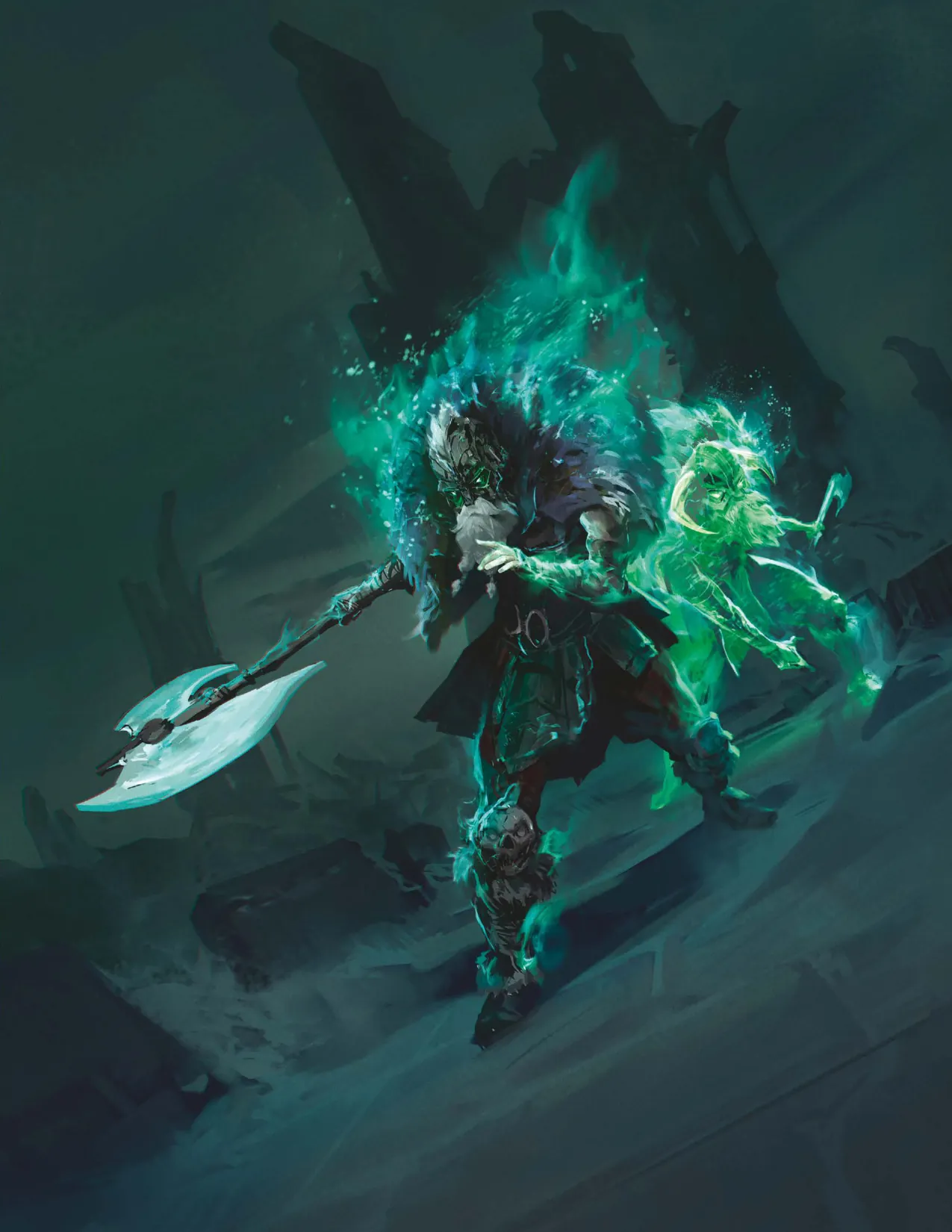
Ahead, the pyrewight stood a seething vigil over greed gone wild. Though its will was not its own, its intent could not be clearer: hatred, wrath. To it, they were its vile slavers. It waited, always, upon reckoning. With the timeless patience of the undead.
“That fucking thing …” Estrid began, but what could be said? A horned helmet concealed its face, but not its shaggy white beard or glowing green eyes. Across fur-mantled shoulders, blue flames burned but never consumed.
“It does more killing than any ten of us. Captain’s got it under control.”
True, it had kept them alive. But one thing did not cancel another.
She recalled its sad origin. It had whispered the tale during their voyage in a deep gravelly voice, hoarse with the rage of centuries. A deceitful skald wove false sagas at its funeral. For dishonorable death, the gods condemned it to endless suffering. A cautionary tale, but what was the lesson? Sit farther from the souls of dead raiders, she decided.
At the longships, the captain tallied their takings with a stick in the snow. She muttered how three longships with fifteen oarsmen each could haul ten captives plus however many stones worth of goods. She sounded more like a clerk than a discovery cleric. Yrsa Badsmith cut a mean figure, even wearing plate. Estrid would give half her share for the woman’s fiery red hair.
“Drop what you’ve got,” Yrsa instructed without looking up. Brain residue dripped from the morningstar in the loop on her hip. They did as they were told. She went on about how a few of their crew had chased after stragglers into the woods, implying that they should round them up. Tides, timing—that kind of thing. When she stopped talking, it meant for them to go.
“I could do with a long rest,” Estrid said, once they were away. The raid had left her emptied of arcane energy.
Haukr’s own tired eyes held no sympathy: wizards were always resting. “Come on.” He wild-shaped into a badger, picked up a scent, then stalked away before she could protest.
They trekked overland nearly half an hour, losing the sound of the sea, and found their raiders, a pair of them, absent heads in a copse of black leafless trees. Haukr reverted, then bent over the bodies, which twitched as still-beating hearts pumped blood into spreading pools. They’d just missed the killers.
“We should have walked slower,” she said, bracing for a second ambush. He ignored her, striding forward with his chin raised, daring them out. She prepared to run, but relaxed when nothing happened.
He spit. “Can’t you do that thing that lets you speak with the dead?”
“Talk how?” She pinched the bridge of her nose. “They don’t have heads.”
He crossed his arms. “They don’t have breath either, but that’s never stopped you.” His tone suggested she should watch hers, so she left it alone.
They looted their crewmen before returning with their report, which only made Yrsa angry: “You didn’t investigate further?”
Estrid tried to look sad and repentant but couldn’t match Haukr’s sincerity. Their expertise, which was another way of saying limitations, centered on fireballs and shillelaghs. Past that, it was their necks. But Haukr opened his mouth and let the stupid out: “You want that we should solve the whole mystery of what happened?”
Yrsa rested her chin on a steel gauntlet. “I think we’d better.” Who knew her reasons?
A wordless grumble stirred in Estrid’s throat. She mustered a dozen axmen, selecting barbarous types that could soak a few arrows on her behalf. Haukr led them back through the trees. The talk along the way was of woods-witches, secret altars, pagan gods.
When they arrived, the bodies weren’t there anymore. Estrid didn’t detect any trace of necromancy. As they went on, she recalled details she’d ignored before and kept circling the tiny shrines hidden in each of the dingy houses. None featured any gods of the Stone Court.
Haukr touched her arm almost tenderly. “Pay attention.” Their musclebound escort had fanned out amidst tall stone cairns carved with runes. Shadows circled within a spreading mist, and the crunch of snow underfoot sounded of rodents gnawing at bones. “How daring,”—a shrill piercing voice came from all around—“that you deign to desecrate my temple.”
Estrid found herself unable to choose between sarcastic quips. Should she mention that no one said “deign,” or express her disappointment in what passed for temples in those parts? Probably, someone charismatic could have de-escalated the situation. Haukr shook his head at this failure of leadership.
A huldra stepped from the mist, a fey woman of supernatural beauty: buxom, with a long sinuous tail and feline ears. Iron scales covered her flesh in the more interesting places but left enough skin exposed to hold attention. Estrid elbowed Haukr to break off his distraction. Enchantment seemed a terrible way to die. All had heard stories of explorers forced to dance until the cold closed icy graves around them. Two hulking wickerthings flanked the huldra, knotted wooden constructs made of roots.
Another might have rallied her side with words of courage or diffused the tension with laughter. Alas, wizards were scholars, for better or worse. “Interesting fact,” she told the warriors forming a circle around her. “Huldra eat the bodies of their victims.” This proved motivation enough. The raiders broke ranks and surged forward. Hefting axes, screaming battle cries. Steel bit wood. Blood stained snow. Bodies leached their warmth into the earth.
At such times, a wizard wanted spell-storing staves, but she wasn’t about to swap her cozy ring for a little utility. “Wait,” she told no one. “I think I have a scroll for this!” She dug through her satchel, battle ensuing around her.
Meanwhile, Haukr became menace incarnate. Each blow received warped his body in strange new ways. Skin hardened to a mottled shell on one shoulder, even as his thigh knit back together, expelling a wooden sliver. The arm that had been a bone club transformed into a bladed claw, leaving long lacerations across wooden constructs.
“I’ve got it here somewhere,” Estrid assured. The huldra’s iron-sharp fingers cleft bearded chunks of face. She stepped into a tree, only to emerge from another some distance away. Splinters exploded from its trunk into her assailants.
By the time Estrid found what she was looking for, her escort had reduced one wickerthing to firewood. The
other broke through their line, seized her by the waist, and lifted her off the ground. Impeccable timing. She unrolled the scroll and read the words. Then, as the scroll vanished, she set her hands on either side of its head— burning hands.
The wickerthing caught flame, released her, and mindlessly sprinted away. Absent her champions, the huldra gave a spite-eyed stare filled with vengeful promise, then warped away with a single misty step. Things were over as sudden and oddly as they’d begun.
Haukr touched a hand to a wounded woman’s knee to cure her wounds.
“Gods, where’s your ear?” Estrid asked him, staring at the gash beneath his temple.
He touched the spot, felt the absence, then wiped blood from his hand and shrugged. “If you find it lying about, you can keep it,” he said. His flat tone seemed to accept the loss as the price for keeping his life. Four of their twelve had fallen, which was not bad math considering the foes they had faced. A quick glance, though, showed that few who remained were whole. She dug through a pile of wickerthing remains, disappointed to find them perfectly mundane. Just kindling. She gritted her teeth. Where was the upside?
As if sensing this, Haukr said, “You could always solve the mystery.” No doubt, her pout was unbecoming. Estrid nodded—no need to look ugly on top of it all. She considered the facts, drew lines between them. Wasn’t it obvious? The fishing village had failed to repel raiders enough times to seek protection from greater powers. They were willing to worship them as “higher powers” if it meant saving their skins.
“That’s how a bunch of clam rakers turn fairy-cultists,” she explained. The stragglers pursued into the woods must have been wickerthings disguised by illusion. A known tactic, the right number. No other answers presented themselves. Her findings solved nothing.
“You seem better, at least.” Her cheer seemed to cheer him.
She tried to feign indifference, but a smile slipped through. They’d been walking. The way back felt heavy when there were fewer of you with bad news to deliver. Tired aches and sore feet took their toll. Estrid distracted herself with dreams of warm weather and pomegranate juice. Her tongue tasted of all sweetness.
She felt certain the huldra stalked them invisibly. Sometimes she heard or saw motion, but she didn’t need it as proof. The energetic signature of sorcery was unmistakable to attuned senses. However, she had nothing to gain by doubling back to deal with it. In their present state, it could only make things worse. For her, the best cure for dread was always foolishness. She cast a minor illusion on Haukr’s shoulder. A tiny walrus wearing a brassiere gave him a sultry wink. He waved it away, but a grin tugged at the corner of his cheek.
Back at the beach, the cargo was stowed, and crews sat around longships waiting. They tossed dice made of bone
and stitched each other’s wounds while crafting the stories that would go with them. What could be better than mead by the fire—warmth inside and out?
A pity the next violence always came sooner than you thought.
Haukr’s shape altered in her periphery: taller, wider, a bluish tinge to his skin. Not one of his usual tricks and not applied not to him alone. When she scanned the others with her, she saw that all were made to look like Tallfolk, frostborn descendants of giants. Often hostile. Perhaps, in her exhaustion, Estrid was hallucinating? No, she knew it was wishful thinking. Their fey follower had cast a spell of seeming to stir the waiting crew: to their feet, to arms, to battle.
“What’s going on?” someone called. Those beside her drew weapons of their own. If she could stall, they’d see—wouldn’t they?—that she and hers were too short for giants, that they spoke with their own true voices.
But all were on edge. The momentum of failure couldn’t be stopped. Cruel laughter echoed from somewhere as the crew clashed with itself, a bloody, brotherly civil war in minor.
“Stop!” Estrid raised her arms and waved them. “No use.” Haukr stepped past her. He understood what she would never accept, that you couldn’t reason with an axe. That no spell was needed to rile old hatreds. And so, their weapons wrote a tragedy.
Metal, flesh, blood, bone, sand. The pyrewight exulted, threshing through men as though they were wheat. Red spray. It halved them at the hips with its greataxe.
Estrid made for Yrsa, Captain of Captains, Maiden of the Sea. If anyone could end the senseless massacre, it was her. Instead, she swung her morningstar. “It’s me.” Estrid backpedaled. “Stop this madness!” She dodged again, but fell, and knew she wouldn’t dodge a third time. Then a purple barb slammed into Yrsa’s arm, attached to Haukr’s fist. Morningstar dropped from gauntlet. And a purple stain crept up Yrsa’s veins, through her neck and into her face. She grasped her collar, choking, as the focus slipped from her eyes.
“Shit.” Haukr had nothing sage to say on the subject. Saving Estrid had damned them all. With concentration lost on the binding spell, the pyrewight had been unleashed. At the same time, the spell of seeming ceased, and the crew could see they were fighting each other. It was too much to know. Should they drop their weapons or weep?
Through the paused combat, the pyrewight strode calmly toward Yrsa. With the greatest ease, it ripped her arm from the shoulder and beat her to death with it. She, its hated captor. Her body sank further beneath each blow, clumping the sand with great gouts of blood. Such brutal excess brought a calming clarity: leftover crew was wordlessly united against a single terrible enemy. While captives ran free, they encircled the pyrewight.
Estrid had a poor view of events as she fled—they were not that creature’s equal. She didn’t have to glance back to
know the sound of burning longships, the feeling of dead hope. Maybe it was justice. Their way home had been a place of chains.
“The spoils …” Haukr had followed. Estrid shook her head. “Silver’s the best of it, even melted. We can’t spend any if we’re dead.” She knew how to make sense in a pinch. Maybe that’s why so many stood around her, nearly ten, looking for answers. If they called a vote, would she be named captain? It didn’t matter. The pyrewight would hunt and kill them all. A simple plan seemed best. “Our odds are better in the woods: get ahead, lay a trap.” Things a raider could understand.
Nods all around. They moved for as long as they had light. Silence had a way of calling errors to mind, lacing the air with shame, regret, and confusion. Despite that blanket of sorrow, the nearness of death heightened the beauty of nature. Breathtaking rocky islets, groves encased in crystalline ice scintillating under the setting sun. Then a lime-green borealis swirled the dark blue sky as it sunk into blackness, with stars all around as spectators. She doubted she would have noticed if things were going well.
Haukr planted his feet in a snow-crusted clearing surrounded by cover. “Here’s as good as anywhere.” Best to choose before the shadows settled. Across a distant plain, a herd of majestic sleipnir gracefully galloped past, those eight-legged horses so loved by the gods. Manes flowing—wild were the only kind. Awe held her breath hostage. They were a sign, some insisted. For her, they sparked inspiration.
Once they’d made their preparations, all they could do was wait. Estrid hid with Haukr on a snowy mound behind tree roots. Not by accident, a congested hiding place where two were forced to huddle close. “You’re attractive, sometimes.” She led with an accurate statement.
He laughed. “You picked a good time to mention it.” She wondered how fast they could get their clothes off, then on again, plus everything in between when the pyrewight interrupted by stomping into view. Cold dead flesh still blazed with flame. Its limp left no doubt it had been damaged by braver men before them. Hopefully, they’d dulled its axe as well.
Her eyes asked Haukr if he remembered the plan. He nodded that he did. She looked at his lips. They could kiss, but what would be the point? He smiled, then leapt out, and all the warriors followed while she stayed behind to recall the shape of wild beasts in flight. Then Haukr did what none would expect of a raider: he read. The scroll she gave him vanished. Then bright pink light fell onto the huldra hiding among them—fairy fire for a fairy creature.
The startled pyrewight leapt upon her. It could only think her their summoned champion, and she could do naught but fend it off. Meanwhile, they employed the wisdom of ages—they ran. She polymorphed into a sleipnir and carried as many as she could.
Trees flitted by as they went. The sound of her own hooves pounding felt electric. Worst case scenario, the
two creatures would realize the farce, but Estrid doubted they could work at vengeance together. Best case? They’d kill each other. More likely, she and Haukr would finish the wounded victor. But that was a problem for another day. Speed filled her with bliss. It wasn’t hard to figure how to neigh with glee.
Again, they returned to the beach. If it wasn’t one, it was another. Cycles of violence in a land that pitted the survival of living things against each other. Where the reward for victors was continued struggle.
The villagers they’d captured were villagers again. What plunder the remaining crew recovered, they returned to the houses they’d emptied with bloodshed, houses they installed themselves in. Without longships,
they would have to wait and steal those of the next raiders come to shore. Until then, Haukr and Estrid stood in the longhouse before a large stone chair, wondering who should sit. Who was best suited for what laid ahead? Numbness had replaced her thoughts, and she’d run out of feelings to feel. They might not get the weeks it would take for all that had happened to settle because things never stopped.
When he cleared his throat, she said, “Fine, we can be both be jarls.” Then she led him to the bedroom for a long rest at last. Grimnir, no doubt, would come to collect. That, in the only coin it knows—in blood. None knows what form their death will take, only that it comes.